Showing posts with label bulb corm rhizome tuber. Show all posts

Sunday, December 26, 2021

ARACEAE FAMILY

The Araceae are a family of monocotyledonous flowering plants in which flowers are borne on a type of inflorescence called a spadix. The spadix is usually accompanied by, and sometimes partially enclosed in, a spathe or leaf-like bract. Also known as the arum family, members are often colloquially known as aroids. This family of 140 genera and about 3750 known species. It is most diverse in the New World tropics, although also distributed in the Old World tropics and northern temperate regions

Arum italicum is a species of flowering herbaceous perennial plant in the family Araceae, also known as Italian arum and Italian lords-and-ladies. It is native to the Mediterranean region (southern Europe, northern Africa, and the Middle East). It is also naturalized in Great Britain, the Netherlands, CrimeaCaucasusCanary IslandsMadeiraAzoresArgentina and in scattered locations in the United States.

Two images showing ripening berries


References                             ...                      
ITIS.

 __________________________________________________© 2021 Hyden Photography
for 
Grassroots Horticulture __________________________________________________

Tuesday, December 7, 2021

Family | Cannaceae

__________________________________________________
__________________________________________________

Canna or canna lily is the only genus of flowering plants in the family Cannaceae, consisting of 10 species. Cannas are not true lilies, but have been assigned to the order Zingiberales in the monocot clade Commelinids, together with their closest relatives, the gingersspiral gingersbananasarrowrootsheliconias, and birds of paradise.


Canna leaf


Cannas are one of the most popular garden plants internationally. They are tropical or subtropical so they will survive being placed in a boggy area. A close cousin, ginger, is edible as is the canna. With proper preparation they produce a starch suitable for noodle preparation. Throughout the world the seeds are used for dyes, musical instrument, and jewelry, Leaves are utilized to make paper, rope and fermented to make alcohol. 

Cannas can be found with red, orange, and yellow flowers and green or maroon leaves


Dallas Arboretum, fall 2019                                                       photograph by Catherine Hyden
Canna
Dallas Arboretum, fall 2019                                                       photograph by Catherine Hyden
Cannaa
Dallas Arboretum, fall 2019                                                       photograph by Catherine Hyden
Canna


I have several varieties of canna. One is Picasso and it is a dwarf variety. I like the colorization on this flower. It does look as though paint was splattered.

Watercolor effect


All material © 2022 by Jeanette Hyden
for 
 ~ Grassroots Horticulture ~


_________________________________________________________

Sunday, December 5, 2021

Hardy Water Canna

___________________________________________________
___________________________________________________

Water Feature Gardening 

CREATING interest in a water garden


Commonly known as hardy water canna, powdery alligator flag, or powdery thalia (Thalia dealbata).  According to the Missouri Botanical Gardens, it is found in southeastern lowland regions from South Carolina to Missouri. Thalia is found in boggy areas and swamps and likes an organic loamy soil.


Monday, November 29, 2021

The Snowies: Leucojum, Galanthus, and

Galantheae is a tribe of plants belonging to the subfamily Amaryllidoideae of the Amaryllis family (Amaryllidaceae).

SNOWFLAKE, LEUCOJUM
                                                                  
Leucojum is a small genus of bulbous plants native to Eurasia belonging to the Amaryllis family, known as snowflakes.. 
Leucojum is a compound of Greek leukos "white" and  ion "violet". Other common names include snowbelldewdrop, and St. Agnes'
 flower.
LEUCOJUM


                                                                                             SNOWDROP, GALANTHUS
SNOWDROP Galanthus 
Galanthus comes from the Greek words gala meaning milk and anthos meaning flower.
Nivalis means snowy.
Galanthus nivalis, commonly called snowdrop, is a bulbous perennial that is native to Europe and southwestern Asia. It has escaped gardens and naturalized in parts of eastern North America. It is a true harbinger of spring that typically blooms from late February to late March in the St. Louis area, often poking its head up through snow cover if present. The common name refers to the supposed resemblance of the flowers to drops of snow. Each flower has six tepals (three spreading outer tepals and three shorter inner tepals).
Easily grown in average, medium, well-drained soils in full sun to part shade. Prefers moist, humusy soils in part shade. Grows particularly well under deciduous trees where exposure to the sun is full in early spring but gradually changes to part shade as the trees leaf out. Also prefers cool climates, and is somewhat short lived when grown south of USDA Zone 7. Plant bulbs 2-3” deep and space 2-3” apart in fall. In optimum growing conditions, it naturalizes well by both self-seeding and bulb offsets. Allow foliage to yellow before removing it from garden areas. If left alone, foliage disappears by late spring as bulbs go dormant.
Best massed in sweeping drifts in areas where they can naturalize, such as woodland margins or in lawns under large deciduous trees. Also effective in groupings in rock gardens, border fronts, in front of flowering shrubs or along walks or paths. Mix with other early flowering bulbs such as Eranthis (winter aconite).


                                                                                             SNOWFLAKES, ACIS
Acis is a genus of perennialherbaceous and bulbous plants in the amaryllis family (Amaryllidaceae, subfamily Amaryllioideae). The genus consists of nine species distributed in Europe and Northern Africa. Acis was previously included in Leucojum; both genera are known as snowflakes.


REFERENCES.                                          
  1. A Gardener’s Guide to Snowdrops: Second Edition by Freda Cox Crowood Press 2019.
  2. A Plant Lover’s Guide to Snowdrops by Naomi Slade Timber Press 2014.
  3. The Galanthophiles: 160 Years of Snowdrop Devotees by Jane Kilpatrick and Jennifer Harmer Orphans Publishing 2018.
  4. Snowdrops: A Monograph of Cultivated Galanthus by Matt Bishop, Aaron Davis, and John Grimshaw Timber Press 2006.
  5. Some Snowdrops: A Photographic Ramble by Anne C. Repnow, Davidia Press.  2020.
  6. Stern, F C. Snowdrops and Snowflakes: A Study of the Genera Galanthus and Leucojum. London: The Royal Horticultural Society, 1956. Print.  
  7. Wareham. Anne, Garden Rant. February 4, 2022. https://gardenrant.com/2022/02/snowdrops.html. 
  8. "Joe Sharman, the ‘King of Snowdrops’, and the tale of the most expensive snowdrop ever sold", Country Life, February 6, 2021. Monksilver Nursery.  
  9. Carolyn's Shade Garden, Snowdrop Catalog 2022.
  10. "The Mysterious Appeal of the Dainty Snowdrop." The Washington Post, February 4, 2019.


Hardy Amaryllis | St. Joseph's Lily

______________________________________________________________________________________________________Spring Flowering HardyAmaryllis

Hardy Amaryllis, St. Joseph's Lily 
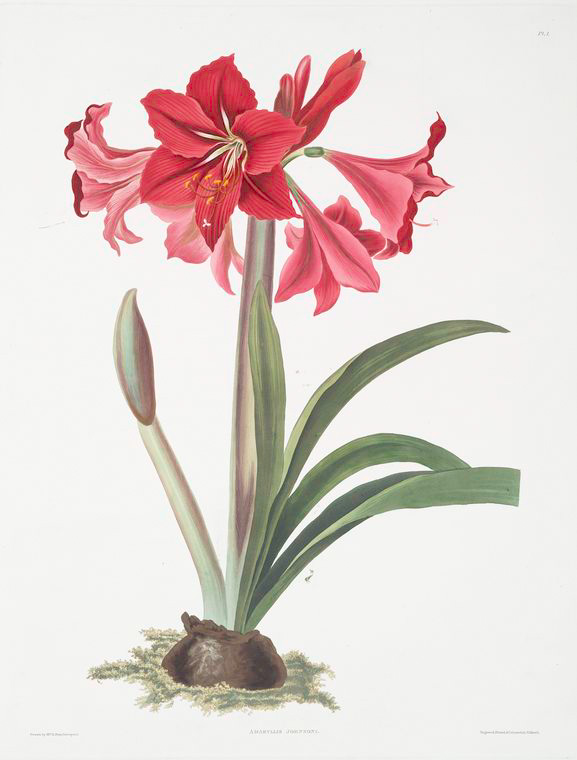
(Hippeastrum johnsonii)
April Bloom in Texas

These Amaryllis were grown in Louisiana, brought to Texas, and are over fifty years old. From my research the Hippeastrum originated in South America. Around 1750, John Johnson, a clockmaker living in Prescot, England took the Latin named, Hippeastrum reginae known additionally as Amaryllis de la reine [Mexican Lily] and crossed it with Hippeastrum vittatum producing Hippeastrum johnsonii. Raised by Johnson in Lancashire, England, 1810, and a year later by the Dean of Mancester University, Henry William Herbert, son of the botanist. This is the common Amaryllis of our Southern gardens. It is one of the best for the beginner, as it is easy to flower, very fine and slightly fragrant. Height: 22-26" Exposure: Full sun to light shade outdoors Hardiness: Zones 8-10.
Height: 22-26" Exposure: Full sun to light shade outdoors Hardiness: Zones 8-10.


Hardy Amaryllis, St. Joseph's Lily 
(Hippeastrum johnsonii)

Hardy Amaryllis, St. Joseph's Lily 
(Hippeastrum johnsonii)

Hardy Amaryllis, St. Joseph's Lily 
(Hippeastrum johnsonii)


"The lily is associated with St. Joseph, spouse of Mary, through an ancient legend that he was so chosen from among other men by the blossoming of his staff like a lily. St. Joseph's Day is March 19.  In religious art the lily is used as an emblem of St. Joseph, and similarly in religious flower symbolism the names "St. Joseph's Staff" and "St. Joseph's Lily" have been applied to a number of flowers.
Joseph, The carpenter of Nazareth, is also venerated as the patron of all workmen, with feastday on May 1st, and thus as the patron of all who work for the building of God's Kingdom on earth as it is in heaven."                                                                              "The just man shall blossom like the lily" 

Index
Amaryllis Johnsonii
from: Selection of Hexandrian plants, belonging to the natural orders Amaryllidae and Liliacæ, from drawings by Mrs. Edward Bury, Liverpool, 1831-1834. Havell, Robert (1793-1878) (Engraver) Source: From The New York Public Library


Historical Botanical Artists with Hippeastrum Illustrations

Historical botanical illustrations were made of this flowering plant by Pierre Joseph Redoute (1759-1840). LINK: (https://digitalcollections.nypl.org/search/index?utf8=%E2%9C%93&keywords=Redoute#)


Additional Flowers in the Amaryllis Family
Check for other beautiful flowering Amaryllis related bulbs including Crinum  and Spider lily.

Futher Reading:


Hippeastrum : The Gardener's Amaryllis, Portland: Timber Press, 2004. New Wave Hippies an Extract from Hippeastrum, The Gardener's Amaryllis


Red Spider Lily | Lycoris radiata

__________________________________________________
Fall Flowering Amaryllis

Lycoris radiata is one of the most rewarding, reliable, and incredibly beautiful bulbs one can grow here in north Texas.  The bulb will spring forth with a stem and then flower in the fall season, sometimes in great profusion I believe the success of flowering depends on the rainfall from the previous summer. The foliage appears after the flower and almost never suffers frost damage. There are limited pests or diseases. They become dormant  in the summer as the foliage dies back.  The tall bloom stalks pop up almost overnight after the first good early autumn rains or hurricane season. They produce a dazzling display of feathery red blossoms up to 6 inches across and are a wonderful speciman for the landscape garden when little else is blooming in the autumn.
Red Spider Lily, Surprise  Lily. Hurricane Lilyy

The lycoris bulb grows to a height of 12-18 in. (30-45 cm) and should survive  in USDA Zone 7a: to -17.7 °C (0 °F) to USDA Zone 9b: to -3.8 °C (25 °F). It prefers a sunny to partial shade exposure and regular watering planted in a loose well drained soil.  It can be used as a border in front of perennial shrubs and it attracts butterflies.

The earliest reference I have found for the red spider lily growing outside it's native environment, so far, is Camden Park, Australia. Now, whether it was growing in Australia before the landing of the HMS Endeavour at Botany Bay on April 29 1770 is the question

It is believed to have been grown in Japan prior to the 19th Century.  It has been suggested that they were introduced into Japan from China along with rice cultivation.

__________________________________________________________________________

The red spider lily appears after a good rain in the fall. I have placed hundreds of  these bulbs in four large pots placed along a crescent shaped bed that rounds out a corner of our lot. I also included two

The bulbs are frost tender (7b-8a) so I am happy they have survived two years in the pots. 


In the United States Lavinia Cole Roberts is credited with sharing this beautiful bulb with other gardeners throughout the warm southern states. Lavina was the niece of Captain William Roberts. He gave her three bulbs offered to him on an expedition in 1854. Lavina's home and garden is located in New Bern, North Carolina. Details here.


Below is one of the first botanical prints I could find. It is from the publication, The Botanist Repository, published by Henry Cranke Andrews (1770 – 1830) in 1801. Andrews, through his marriage to  Anne Kennedy, was affiliated with the firm, The Lee and Kennedy Vineyard Nursery, located in Hammersmith, London. 


The Botanist Repository, published by Henry Cranke Andrews (1770 – 1830) in 1801
The second botanical print I have found, in chronological order, is the 1811 print from the Stuttgart Palace Garden by artist and publisher, Johann Simon von Kerner (1755-1830).

Kerner, J.S.,
Hortus sempervirens, vol. 29: t. 344
 (1811)
Source: Plant Illustration


The 1822 botanical art below is a print published in the Botanical Register. This time the artist is M. Hart. I have not been able to locate additional information on M. Hart but there were two botanical "Hart" artists in this area, the other artist was I.J. Hart, James McDougal Hart (1828 – 1901)). The Botanical Register, subsequently known as Edwards' Botanical Register, was an illustrated horticultural magazine that ran from 1815 to 1847. The Botanical Register was started by the illustrator Sydenham Edwards. After Edwards death, James Ridgway became publisher. Ridgway issued nine volumes between 1820 and 1828.
M. Hart
Edwards' Botanical Register
 (1822)
Source: Plant Illustration


The last botanical print is by artist, Louis Severeyns (1860).
Lycoris radiate (L’Herit.)
La Belgigue horticole, journaldes jardins et des vergers, vol. 10 (1860)
 Van Houtte, Louis (Severeyns, Stroobant and De Pannemaker)
Louis Severeyns, published in Belgium


References.                                                                  
  1. Introducing Lycoris to. U.s. Flower Lovers." Agricultural Research Washington. 53.12 (2005): 12-13. Print.
  2. Koyama, Tetsuo. The Japanese Species of Lycoris. Place of publication not identified, 1959. Print.
  3.  Hori, TA; Hayashi, A; Sasanuma, T & Kurita, S (2006), "Genetic variations in the chloroplast genome and phylogenetic clustering of Lycoris species", Genes Genet. Syst., 81 (4): 243–253, doi:10.1266/ggs.81.243, PMID 1703879 
  4. Evans, Erv & De Hertough, A.A., Lycoris radiata; Spider lily, Naked lily, Red spider lily, NC State University, archived from the original on 2011-09-13, retrieved 2011-09-13.   
  5. Klingaman, Gerald (2000), Plant of the Week : Red Spiderlily, University of Arkansas Division of Agriculture, Cooperative Extension Services         
  6. The Plant List.   
  7. Stevens, P.F., Angiosperm Phylogeny Website: Asparagales: Amaryllidoideae
  8. Kew World Checklist of Selected Plant Families.   
  9. Knox, Gary W. (2011), Hurricane Lilies, Lycoris Species, in Florida, Environmental Horticulture Department, Florida Cooperative Extension Service, Institute of Food and Agricultural Sciences, University of Florida, retrieved 2012-04-12. 
  10. Mathew, Brian (1978), The Larger Bulbs, London: B.T. Batsford (in association with the Royal Horticultural Society), ISBN 978-0-7134-1246-8.    
  11. William Herbert. 1819. Botanical Magazine 47: pl. 2113