Showing posts with label Flower color | Blue/ purple. Show all posts

Monday, May 23, 2022

Centaurea L.

___________________________________________________
___________________________________________________

The blue spidery flowers of mountain bluet bloom in the spring and summer. They are ideal for borders, cottage gardens, and even rock gardens. Here, placed amongst hostas, they thrill after the tulips have shed most of their petals and the alliums are beginning to shine with their beautiful tall purple globe shaped flowers of spring. It's the natural order of the gardens star appearances.


Early morning dew graces the buds as they begin to break open on a foggy morning. In the shady areas of this garden lily of the valley is in full bloom, and the scent wafts through the air at all hours of the day.


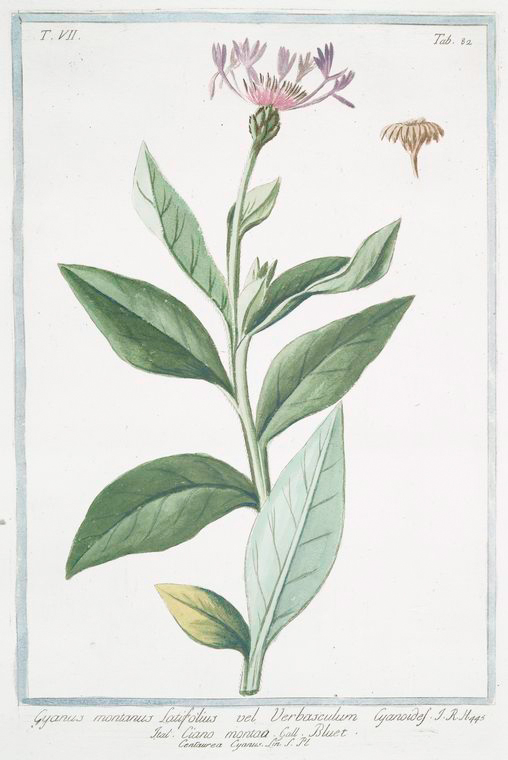
Dew covered Mountain Bluet (Centaurea montana)   
It blooms in late May and early June in hardiness zone 5.

Mountain bluet, also known as perennial bachelor buttons is included in the aster family. It is found as a native in central and southern Europe.
Index
Cyanus montanus, latifolius vel Verbaculum Cyanoides

 Grow in a full or partial sun exposure. In a partial sun exposure the plant is more likely to get mildew, but they can be cut back and the foliage removed. At this point the plant will regrow  and bloom a second time during the summer. It will survive in hardiness zones 3-8 with medium to dry water conditions. One to two feet is the approximate height and spread and it will reseed in situ, but is not invasive. The plants should be divided every three years.


CORNFLOWERS
Centaurea cyanus


, 


Plant lovers, gardeners, and botanists sometimes experience frustration trying to nail down an exact plant that they have seen and might like to add to their own garden or plant knowledge. Several professional groups are working hard to speak in the same language for identity purposes and recognize ancestry, ethnobotonists, are the Henry Lewis Gates of "Finding your Roots" fame.

Below, I have combined the cornflowers and knapweed from the Ladybird Johnson Wildflower Center with those listed at the USDA site and the ITIS site.

DATABASE SYMBOL CODETAXACOMMON NAMEITIS - ACCEPTEDNATIVECITE
USDACENTACentaurea L.knapweedCentaurea L.
ITISTSN 36950Centaurea L. – accepted – knapweed, star thistleknapweed, starthistleCentaurea L.
IPNI330045-2Centaurea LknapweedCentaurea L.
IPNI56874-3Centaurea LknapweedCentaurea L.
ITISTSN 36951Centaurea americana Nutt. – not accepted – American basketflower, American star thistle, American star-thistleAmerican basketflower, American star thistle, American star-thistlePlectocephalus americanus (Nutt.) D. DonUSA: AZ, NM, TX, OK, KS, AR, MO, IA, IL, WI, GA, NY; MEX: Chihuahua, Coahuila, Durango, Hidalgo, Nuevo Leon, Oaxaca, Querétaro, San Luis Potosí, Sonora, tamaulipas; HONDURAS; EL SALVADOR.https://www.itis.gov/servlet/SingleRpt/SingleRpt?search_topic=TSN&search_value=36951#null/
WORLD PLANTS Plectocephalus americanus (Nutt.) https://www.worldplants.de/world-plants-complete-list/complete-plant-list/?name=Plectocephalus-americanus#g-Plectocephalus americanus (Nutt.)USA: AZ, NM, TX, OK, KS, AR, MO, IA, IL, WI, GA, NY; MEX: Chihuahua, Coahuila, Durango, Hidalgo, Nuevo Leon, Oaxaca, Querétaro, San Luis Potosí, Sonora, tamaulipas; HONDURAS; EL SALVADOR.Hassler, Michael (2004 - 2022): World Plants. Synonymic Checklist and Distribution of the World Flora. Version 13.0; last update May 29th, 2022. - www.worldplants.de. Last accessed dd/mm/yyyy.


COL COL Identifier

4K3BT

Plectocephalus americanus (Nutt.) https://www.catalogueoflife.org/data/taxon/4K3BT Plectocephalus americanus (Nutt.)
IPNI189870-1Centaurea americana Nutt.American star-thistlePlectocephalus americanus (Nutt.) D.Don, Brit. Fl. Gard. [Sweet] 4(ser. 2, 1): t. 51 (1830).IPNI (2022). International Plant Names Index. Published on the Internet http://www.ipni.org, The Royal Botanic Gardens, Kew, Harvard University Herbaria & Libraries and Australian National Botanic Gardens. [Retrieved 15 March 2022].
USDACEAM2Centaurea americana Nutt.American star-thistlePlectocephalus americanus (Nutt.) D. DonUSA: AZ, NM, TX, OK, KS, AR, MO, IA, IL, WI, GA, NY; MEX: Chihuahua, Coahuila, Durango, Hidalgo, Nuevo Leon, Oaxaca, Querétaro, San Luis Potosí, Sonora, tamaulipas; HONDURAS; EL SALVADOR.
LBJWFCCEAM2Centaurea americanaAmerican Basket-flower
American Star-thistle
Basket-flower
Star Thistle
Shaving Brush
Basket Flower
Plectocephalus americanus (Nutt.) D. DonUSA: AZ, NM, TX, OK, KS, AR, MO, IA, IL, WI, GA, NY; MEX: Chihuahua, Coahuila, Durango, Hidalgo, Nuevo Leon, Oaxaca, Querétaro, San Luis Potosí, Sonora, tamaulipas; HONDURAS; EL SALVADOR.
ITIS TSN 36970Centaurea rothrockii Greenm. – not accepted – Rothrock's knapweedPlectocephalus rothrockii (Greenm.) D.J.N. HindRetrieved [month, day, year], from the Integrated Taxonomic Information System (ITIS) on-line database, www.itis.gov, CC0
https://doi.org/10.5066/F7KH0KBK
IPNI51292-2Centaurea rothrockiiPlectocephalus rothrockii
LBJWFCCEROCentaurea rothrockiiRothrock's Knapweed
Rothrock’s Basketflower
Mexican Basketflower
Plectocephalus rothrockii (Greenm.) D.J.N. Hind
ITISTSN 36974Centaurea transalpina auct. non Schleich. ex DC. – not accepted – alpine knapweedalpine knapweedCentaurea nigrescens Willd.Retrieved [month, day, year], from the Integrated Taxonomic Information System (ITIS) on-line database, www.itis.gov, CC0
https://doi.org/10.5066/F7KH0KBK
LBJWFCCETR6Centaurea transalpinaAlpine Knapweed
Tyrol Knapweed
Short-fringed Knapweed
Centaurea nigrescens Willd.

Resources.                                                    
Dimmitt, Mark A., A Natural History of the Sonoran Desert (ASDM Press, 2000), Centaurea Rothrockii., 2003. Internet resource. Link

Phylogeny of the Centaurea Group (centaurea, Compositae) Geography Is a Better Predictor Than Morphology. Elsevier, 2014. Internet resource.


   IPNI (2022). International Plant Names Index. Published on the Internet http://www.ipni.org, The Royal Botanic Gardens, Kew, Harvard University Herbaria & Libraries and Australian National Botanic Gardens. [Retrieved 15 March 2022].         

ITIS (2022) International Taxonomy Information System.   
      
LBJWC (2022) Ladybird Johnson Wildflower Center.    

USDA PLANTS DATA (2022).                 


    © 2022 by  Hyden Photography
 for 
Grassroots Horticulture
___________________________________________________
___________________________________________________________________________________

Saturday, November 27, 2021

New Spring Favorite | Orris root Iris

______________________________

_______________________________________________________________________

IRIS PALLIDA 'VARIEGATA'

Oris root Iris, Iris pallida

If you have ever made potpourri you will be familiar with this iris. Orris  root is used in designer perfumes and has a violet scent.
_________________________________________________________________________

Iris pallida, Orris root iris 

 Applewood Estate, Horticulture Garden, Spring 2018        _____________________________________________________________________
          

Iris pallida blooms in the spring and has a beautiful lavender ruffled flower. The variegated foliage is lovely after the flowers have faded.


Iris pallida, Orris root iris 

 Applewood Estate, Horticulture Garden, Spring 2018        _____________________________________________________________________
Irises used in Perfumery and Mixology

In her best-selling The Drunken Botanist, Amy Stewart explores hundreds of “plants that create the world’s great drinks,” including iris. She writes:
  • “The pharmacy and perfumery of Santa Maria Novella, established by Dominican friars in Florence in 1221, gained notoriety for its use of the rhizomes of iris. They were not the first — Greek and Roman writings mention it — but their perfumes, cordials, and powders contained liberal doses of this rare and precious substance. Orris was popular not so much for its fragrance — although it does contain a compound  called irone that gives it a faint violet smell — but as a fixative, holding other fragrances or flavors in place by contributing a missing atom that would otherwise make the fragrance volatile and easily released from the solution it is suspended in. None of this chemistry was understood at first. Perfumers and distillers would also not have understood why the rhizomes had to dry for two to three years before they become effective as a fixative. We now know that it takes that long for a slow oxidation process to occur, bringing about the chemical change that causes irone to form from other organic  compounds present in the rhizome. Only about 173 acres of orris are cultivated worldwide. Most of the orris is either I. pallida ‘Dalmatica’, grown in Italy, or . . . I. germanica var. Florentina, grown in Morocco, China, and India. I. germanica ‘Albicans’ is also used in orris production. To extract the orris, the rhizome must first be pulverized and steam-distilled to produce a waxy substance called orris butter, or beurre d’iris. Then alcohol is used to extract an absolute, which is a perfumer’s term for a stronger version of an essential oil. Orris is found in nearly every gin and in many other spirits. Its popularity in perfume is due to the fact that it not only holds the fragrance in place but clings to the skin as well. It also happens to be a very common allergen, which explains why allergy sufferers might be sensitive to cosmetics and other fragrances — as well as gin.”


Iris florentina syn. Iris germanica, commonly known as orris root
Hand-colored engraving by 

James Sowerby 1757-1822; published by Dr. William Woodville, 1752-1805.
_____________________________________________________________________


References______________________________________________

  • Pallida Dalmatica and Orris Root - in Italy, Perfume, Martinis, and Your Garden, article. https://oldhousegardens.com/MoreAboutPallidaDalmatica
  • Stewart, Amy, and Coleen Marlo. The Drunken Botanist: The Plants That Create the World's Great Drinks. United States.
  • Phytochemistry http://www.psna-online.org/
                            

All material © 2018 by Jeanette Hyden for Grassroots Horticulture
___________________________________________________________________________________
___________________________________________________________________________________

Saturday, October 23, 2021

Mistflowers

ORDER | ASTERALES

GARDENING | PLANT ID  

A dynamic study of Eupatorium, Ageratina, Conoclinium, and Chromolaena


CONOCLINIUM

Conoclinium, the mistflowers, is a genus of four species of herbaceous perennial flowering plants, native to North America.The generic name is derived from the Greek words κῶνος (kônos), meaning "cone", and κλινίον (kliníon), meaning "little bed".


Four Species of Conoclinium Mistflowers  
  1. Conoclinium coelestinum. Blue mistflower.
  2. Conoclinium dissectum or Conoclinium greggii. Gregg's mistflower, Palmleaf thoroughwort or Palm-leaf mistflower. Native in TX, NM, AZ.
  3. Conoclinium betonicifolium (Mill.) R.M. King & H. Rob. Betonyleaf thoroughwort.
  4. Conoclinium mayfieldii. Mayfield mistflower.

Conoclinium betonicifolium
Betony-leaf Mistflower, Betonyleaf Thoroughwort
This mistflower is more common on dunes, roadsides, and edges of woods. As a somewhat weak woody perennial it roots at the nodes in sand or sandy clay and found throughout the Texas coast. Does best in full sun but will bloom in shade. It has bluish flower petals and blooms from March through August. It also attracts a host of butterfly species.

Conoclinium coelestinum
Blue mistflower
 grows in eastern Texas and into the eastern edge of the Hill Country.
Map distribution (USDA)
Map distribution (
BONAP)

Conoclinium greggii or Conoclinium dissectum greggii, Gregg's mistflower


Conoclinium mayfieldi, Mayfield Mistflower
This mistflower is found in Mexico. Conoclinium mayfieldii is a reclining herb up to 70 cm (28 inches) tall. Leaves are opposite, egg-shaped.

Below, I have identified, with photographs, two varieties of mistflowers.
The photographs above demonstrate the differences in the leaves. That is the best way to know which one you have. An additional difference is the Gregg's mistflower (Conoclinium dissectum or C. greggii) can be seen blooming in the summer. Generally, my blue mistflower, C. coelestinum, blooms in the fall and continues blooming into November.


Conoclinium coelestinum  ASTERACEAE 
Blue mistflower
 grows in eastern Texas and into the eastern edge of the Hill Country.
Map distribution (USDA)
Map distribution (
BONAP)


Conoclinium coelestinum  ASTERACEAE 
Blue mistflower


These particular plants lived through a very hot and very dry Texas summer.
Texas Discovery Garden, Round Rock, Texas.
Map distribution (USDA)
Map distribution  (BONAP)


Conoclinium greggii or Conoclinium dissectum greggii
Gregg's mistflower
These mistflowers were in the TNLA demonstration garden
at the Dallas Arboretum and Botanical Garden.
The sign would ID the flowers that were in the bed earlier in the season.


Resources for Verification:
Integrated Taxonomic Information System ITIS.gov

Map distribution Texas: 
USDA
http://bonap.net/FieldMaps/Home/Result. artesz, J.T., The Biota of North America Program (BONAP). 2015. North American Plant Atlas. (http://bonap.net/napa). Chapel Hill, N.C.


______________________________________________________________________

EUPATORIUM AND AGERATINA

Bonesets, Thoroughworts, and Mistflowers

Ageratina havanensis, (formerly) Eupatorium havanense. 
Havana snakeroot, shrubby boneset
The bloom time of this photograph is November 2020 in Tarrant County, Texas. The very fragrant flowers attract pollinators.

Ageratina havanensis (Kunth) King & H. Rob.  (formerly) Eupatorium havanense
Havana snakeroot, shrubby boneset, Eupatorium, boneset, thoroughwort, Barba de Viejo
This 2-6’ tall and wide deciduous shrubby perennial can get up to 6’, has white fuzzy fragrant flowers and blooms in the fall. Likes dry feet, full sun, some shade and a variety of soils. Heavy winter shearing promotes denser shape with more flowers the following year. The longer lasting blooms are on the new wood. Has toothed edged leaves that are 1-3” long. A true magnet to hummingbirds, butterflies, and many of other insects.

Leaves, Ageratina havanensis


Additionally:
Ageratina wrightii formerly Eupatorium wrightii
White Mistflower, Wright's Snakeroot, White , White Ageratum
A very drought tolerant native deciduous perennial subshrub that grows 1-2.5’ tall and blooms white from September through November, sometimes earlier. Full sun to partial shade. 

Ageratina rothrockii 
Rothrock snakeroot
found in west Texas. I would definitely include this in the study of mistflowers.

Resources for Verification:
ITIS.gov


              Species of Eupatorium 
 Eupatorium album                                              white thoroughwort
Eupatorium altissimum 
                                 tall thoroughwort
Eupatorium anomalum Nash.                 Florida thoroughwort (hybrid)
Eupatorium capillifolium (Lamarck)      Small dog-fennel
Eupatorium compositifolium Walter.        Yankeeweed
Eupatorium godfreyanum Cronquist, hybrid
Eupatorium hyssopifolium L.             hyssop-leaved thoroughwort
Eupatorium lancifolium (Torrey & A.Gray)  lance-leaved thoroughwort
Eupatorium leptophyllum DC.                false fennel
Eupatorium leucolepis (DC.) Torrey & A.Gray – justiceweed
Eupatorium linearifolium Walter.                    Waxy thoroughwort
Eupatorium mikanioides Chapman – semaphore thoroughwort
Eupatorium mohrii Greene                       Mohr's thoroughwort
Eupatorium paludicola E.E.Schill. & LeBlond – swamp thoroughwort.
Eupatorium perfoliatum L.                 common boneset
Eupatorium petaloideum Britton          showy white thoroughwort
Eupatorium pilosum Walter.                     rough boneset
Eupatorium resinosum Torrey ex DC.      pine barren boneset
Eupatorium rotundifolium L.               roundleaf thoroughwort
Eupatorium semiserratum DC.  smallflower thoroughwort
Eupatorium serotinum L.                             lateflowering thoroughwort
Eupatorium sessilifolium L.                 upland boneset


Eupatorium perfoliatum
Common Boneset
Common Boneset is a very drought tolerant hairy plant that has 3-6’ tall stems with an arrangement of rather dull white fuzzy clusters of flowers and has paired leaves. It blooms June through October and tolerates a variety of soils. 

Resources to verify:
Integrated Taxonomic Information System ITIS.gov


_________________________________________________________________________

CHROMOLAENA

Chromolaena odorata (L.) R. M. King and H. Rob
Jack in the bush, Common boneset
Jack in the bush, Common Boneset is a very drought tolerant hairy plant that has 3-6’ tall stems with an arrangement of rather dull white fuzzy clusters of flowers and has paired leaves. It blooms June through October and tolerates a variety of soils.

_________________________________________________________________________


Bibliography.                                          
           Eason, Michael. Wildflower of Texas. North Adams: Timber Press, Incorporated, 2018.
Ajilvsgi, Geyata, Butterfly Gardening for Texas, TX A & M U. Press, College Station, 2013 Diggs, George, Barney Lipscomb, Robert O’Kennon, Shinners and Mahler’s Illustrated Flora of North Central Texas, Austin College and BRIT Publishers, 1999, pages 572-4 Eastman, John, Wildflowers of the Eastern United States, Stackpole Books, Mechanicsburg, PA, 2014 
Wasowski, Sally & Andy, Native Texas Plants, Landscaping Region by Region, Gulf Publishing, Houston, 1991 Wills, Mary Motz, Howard Irwin, Roadside Flowers of Texas, U of TX Press, Austin, 1969
City of Austin. 2009. Native and Adapted Landscape Plants: An Earthwise Guide for Central Texas. Fourth Edition. Texas Agrilife Extension: Austin. 
Diggs, G.M., B.L. Lipscomb, R.J. O'Kennon. 1999. Shinners and Mahler's Illustrated Flora of North Central Texas. BRIT: Fort Worth.
Diggs, G.M., B.L. Lipscomb, M.D. Reed, R.J. O'Kennon. 2006 Illustrated Flora of East Texas, Volume One. BRIT: Fort Worth. Foraging Tex
The Dirt Doctor, Howard Garrett. www.dirtdoctor.org 
Turner, Billie; Nichols, Holly; Denny, Geoffrey C.; & Doron, Oded. 2003. Atlas of the Vascular Plants of Texas. USDA. 2013. 
Wasowski, S. and A. Wasowski. 1998. Native Texas Plants: Landscaping Region by Region, Second Edition. Lone Star Books: Lanham. 


 My Favorite Online Authoritative Sources for Plant Identification 

Taxonomy Searchable Databases

Professional

IAPT

International Association of Plant Taxonomy (member only)

Http://www.iaptglobal.org (member only)

Professional

IAPT

International Association of Plant Taxonomy (Instagram)

International Association of Plant Taxonomy (member only)

Professional

IABMS

International Association of Botanical and Mycological Societies

https://www.iaptglobal.org/iabms

Professional


TAXON Journal

https://onlinelibrary.wiley.com/journal/19968175


CoL

Species 2000 Catalog of Life

https://www.catalogueoflife.org/


ITIS

Integrated Taxonomic Information System (USGS and Smithsonian

itis.gov


EoL

Encyclopedia of Life

https://eol.org/


BONAP (distribution maps)

Biota of North America

http://www.bonap.org


BONAP

Biota of North America

https://cmr.earthdata.nasa.gov/search/concepts/C1214613085-SCIOPS.html


GBIF

Global Biodiversity Information Facility

https://www.gbif.org/


USDA (maps)

United States Department of Agriculture Plants Database

https://plants.usda.gov/home


ARS-GRIN

Germplasm Resources Information Network (GRIN)

https://www.ars-grin.gov/


LJWC

Lady Bird Johnson Wildflower Center, Austin, Texas Native Plant Database

www.wildflower.org/plants


TAMU (Texas)

Texas A and M University, College Station, Texas (Native trees)

https://aggie-horticulture.tamu.edu/texasnativetrees/


UofTX (Texas)

The University of Texas, Billie L. Turner Plant Resource Center

http://w3.biosci.utexas.edu/prc/K12/


iNat

California Academy of Sciences and the National Geographic Society

https://www.inaturalist.org/


GSPC

Global Strategy for Plant Conservation (GSPC)

http://www.theplantlist.org/


WFO

World Flora Online (WFO)

www.worldfloraonline.org


MBG

Missouri Botanical Garden

https://www.missouribotanicalgarden.org/


NYBG

The New York Botanical Garden (NYBG)

https://www.nybg.org/


RBGE

The Royal Botanic Garden Edinburgh (RBGE)

http://www.rbge.org.uk/


RBG

Royal Botanic Gardens, Kew

https://www.kew.org/


IPNI

International Plant Name Index

IPNI.org


(wetlands)

U. S. Army Corp of Engineers Wetlands, Vermont, N H.

http://wetland-plants.usace.army.mil/nwpl_static/v34/home/home.html


NAEB BRIT

Native American Ethnobotany (BRIT and University of Michigan - Dearborn) (SYOR)

http://naeb.brit.org


NPN

Native Plant Network - USDA Forest Service

https://npn.rngr.net/


SEINet (includes)

SW Biodivirsity

http://swbiodiversity.org/seinet/


Consortium of Midwest Herbaria


Consortium of Southern Rocky Mountain Herbaria


Intermountain Regional Herbarium Network


Madrean Discovery Expeditions (MDE)


Mid-Atlantic Herbaria Consortium


North American Network of Small Herbaria


North Great Plains Herbaria


Red de Herbarios del Noroeste de México (northern Mexico)


SERNEC (Southeast USA)


Texas Oklahoma Regional Consortium of Herbaria (TORCH)


Hyden Photography 
for