
___________________________________________________

The blue spidery flowers of mountain bluet bloom in the spring and summer. They are ideal for borders, cottage gardens, and even rock gardens. Here, placed amongst hostas, they thrill after the tulips have shed most of their petals and the alliums are beginning to shine with their beautiful tall purple globe shaped flowers of spring. It's the natural order of the gardens star appearances.

Early morning dew graces the buds as they begin to break open on a foggy morning. In the shady areas of this garden lily of the valley is in full bloom, and the scent wafts through the air at all hours of the day.

Dew covered Mountain Bluet (Centaurea montana)
It blooms in late May and early June in hardiness zone 5.
Mountain bluet, also known as perennial bachelor buttons is included in the aster family. It is found as a native in central and southern Europe.
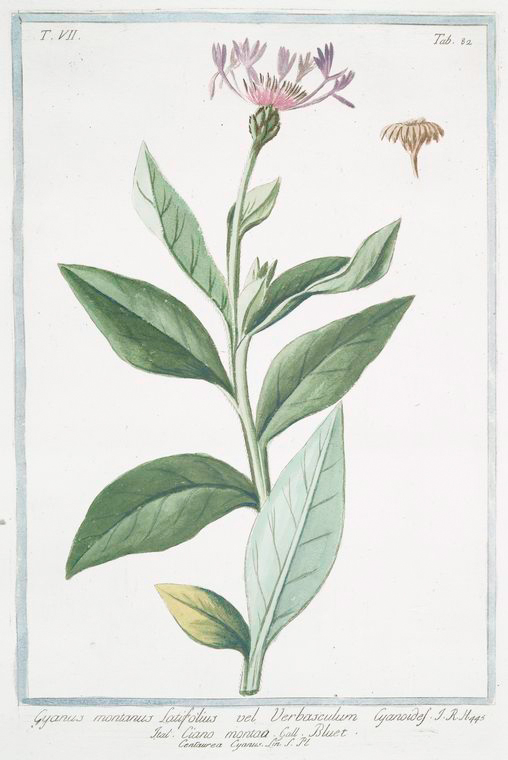
Cyanus montanus, latifolius vel Verbaculum Cyanoides
1772-1793
Bonelli, Giorgio (b. 1724) (Author) Martelli, Niccoló (1735-1829) (Editor)
Source: From The New York Public Library

Grow in a full or partial sun exposure. In a partial sun exposure the plant is more likely to get mildew, but they can be cut back and the foliage removed. At this point the plant will regrow and bloom a second time during the summer. It will survive in hardiness zones 3-8 with medium to dry water conditions. One to two feet is the approximate height and spread and it will reseed in situ, but is not invasive. The plants should be divided every three years.
CORNFLOWERS
Centaurea cyanus


,

Plant lovers, gardeners, and botanists sometimes experience frustration trying to nail down an exact plant that they have seen and might like to add to their own garden or plant knowledge. Several professional groups are working hard to speak in the same language for identity purposes and recognize ancestry, ethnobotonists, are the Henry Lewis Gates of "Finding your Roots" fame.
Below, I have combined the cornflowers and knapweed from the Ladybird Johnson Wildflower Center with those listed at the USDA site and the ITIS site.
Resources.
Dimmitt, Mark A., A Natural History of the Sonoran Desert (ASDM Press, 2000), Centaurea Rothrockii., 2003. Internet resource. Link
Phylogeny of the Centaurea Group (centaurea, Compositae) Geography Is a Better Predictor Than Morphology. Elsevier, 2014. Internet resource.
IPNI (2022). International Plant Names Index. Published on the Internet http://www.ipni.org, The Royal Botanic Gardens, Kew, Harvard University Herbaria & Libraries and Australian National Botanic Gardens. [Retrieved 15 March 2022].
ITIS (2022) International Taxonomy Information System.
LBJWC (2022) Ladybird Johnson Wildflower Center.
USDA PLANTS DATA (2022).
© 2022 by Hyden Photography
for
Grassroots Horticulture
___________________________________________________
___________________________________________________________________________________