Showing posts with label Family | Asteraceae. Show all posts

Monday, May 23, 2022

Centaurea L.

___________________________________________________
___________________________________________________

The blue spidery flowers of mountain bluet bloom in the spring and summer. They are ideal for borders, cottage gardens, and even rock gardens. Here, placed amongst hostas, they thrill after the tulips have shed most of their petals and the alliums are beginning to shine with their beautiful tall purple globe shaped flowers of spring. It's the natural order of the gardens star appearances.


Early morning dew graces the buds as they begin to break open on a foggy morning. In the shady areas of this garden lily of the valley is in full bloom, and the scent wafts through the air at all hours of the day.


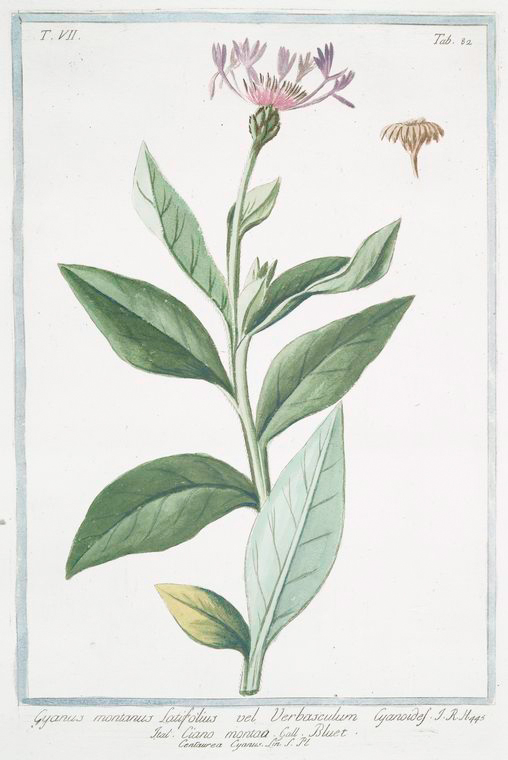
Dew covered Mountain Bluet (Centaurea montana)   
It blooms in late May and early June in hardiness zone 5.

Mountain bluet, also known as perennial bachelor buttons is included in the aster family. It is found as a native in central and southern Europe.
Index
Cyanus montanus, latifolius vel Verbaculum Cyanoides

 Grow in a full or partial sun exposure. In a partial sun exposure the plant is more likely to get mildew, but they can be cut back and the foliage removed. At this point the plant will regrow  and bloom a second time during the summer. It will survive in hardiness zones 3-8 with medium to dry water conditions. One to two feet is the approximate height and spread and it will reseed in situ, but is not invasive. The plants should be divided every three years.


CORNFLOWERS
Centaurea cyanus


, 


Plant lovers, gardeners, and botanists sometimes experience frustration trying to nail down an exact plant that they have seen and might like to add to their own garden or plant knowledge. Several professional groups are working hard to speak in the same language for identity purposes and recognize ancestry, ethnobotonists, are the Henry Lewis Gates of "Finding your Roots" fame.

Below, I have combined the cornflowers and knapweed from the Ladybird Johnson Wildflower Center with those listed at the USDA site and the ITIS site.

DATABASE SYMBOL CODETAXACOMMON NAMEITIS - ACCEPTEDNATIVECITE
USDACENTACentaurea L.knapweedCentaurea L.
ITISTSN 36950Centaurea L. – accepted – knapweed, star thistleknapweed, starthistleCentaurea L.
IPNI330045-2Centaurea LknapweedCentaurea L.
IPNI56874-3Centaurea LknapweedCentaurea L.
ITISTSN 36951Centaurea americana Nutt. – not accepted – American basketflower, American star thistle, American star-thistleAmerican basketflower, American star thistle, American star-thistlePlectocephalus americanus (Nutt.) D. DonUSA: AZ, NM, TX, OK, KS, AR, MO, IA, IL, WI, GA, NY; MEX: Chihuahua, Coahuila, Durango, Hidalgo, Nuevo Leon, Oaxaca, Querétaro, San Luis Potosí, Sonora, tamaulipas; HONDURAS; EL SALVADOR.https://www.itis.gov/servlet/SingleRpt/SingleRpt?search_topic=TSN&search_value=36951#null/
WORLD PLANTS Plectocephalus americanus (Nutt.) https://www.worldplants.de/world-plants-complete-list/complete-plant-list/?name=Plectocephalus-americanus#g-Plectocephalus americanus (Nutt.)USA: AZ, NM, TX, OK, KS, AR, MO, IA, IL, WI, GA, NY; MEX: Chihuahua, Coahuila, Durango, Hidalgo, Nuevo Leon, Oaxaca, Querétaro, San Luis Potosí, Sonora, tamaulipas; HONDURAS; EL SALVADOR.Hassler, Michael (2004 - 2022): World Plants. Synonymic Checklist and Distribution of the World Flora. Version 13.0; last update May 29th, 2022. - www.worldplants.de. Last accessed dd/mm/yyyy.


COL COL Identifier

4K3BT

Plectocephalus americanus (Nutt.) https://www.catalogueoflife.org/data/taxon/4K3BT Plectocephalus americanus (Nutt.)
IPNI189870-1Centaurea americana Nutt.American star-thistlePlectocephalus americanus (Nutt.) D.Don, Brit. Fl. Gard. [Sweet] 4(ser. 2, 1): t. 51 (1830).IPNI (2022). International Plant Names Index. Published on the Internet http://www.ipni.org, The Royal Botanic Gardens, Kew, Harvard University Herbaria & Libraries and Australian National Botanic Gardens. [Retrieved 15 March 2022].
USDACEAM2Centaurea americana Nutt.American star-thistlePlectocephalus americanus (Nutt.) D. DonUSA: AZ, NM, TX, OK, KS, AR, MO, IA, IL, WI, GA, NY; MEX: Chihuahua, Coahuila, Durango, Hidalgo, Nuevo Leon, Oaxaca, Querétaro, San Luis Potosí, Sonora, tamaulipas; HONDURAS; EL SALVADOR.
LBJWFCCEAM2Centaurea americanaAmerican Basket-flower
American Star-thistle
Basket-flower
Star Thistle
Shaving Brush
Basket Flower
Plectocephalus americanus (Nutt.) D. DonUSA: AZ, NM, TX, OK, KS, AR, MO, IA, IL, WI, GA, NY; MEX: Chihuahua, Coahuila, Durango, Hidalgo, Nuevo Leon, Oaxaca, Querétaro, San Luis Potosí, Sonora, tamaulipas; HONDURAS; EL SALVADOR.
ITIS TSN 36970Centaurea rothrockii Greenm. – not accepted – Rothrock's knapweedPlectocephalus rothrockii (Greenm.) D.J.N. HindRetrieved [month, day, year], from the Integrated Taxonomic Information System (ITIS) on-line database, www.itis.gov, CC0
https://doi.org/10.5066/F7KH0KBK
IPNI51292-2Centaurea rothrockiiPlectocephalus rothrockii
LBJWFCCEROCentaurea rothrockiiRothrock's Knapweed
Rothrock’s Basketflower
Mexican Basketflower
Plectocephalus rothrockii (Greenm.) D.J.N. Hind
ITISTSN 36974Centaurea transalpina auct. non Schleich. ex DC. – not accepted – alpine knapweedalpine knapweedCentaurea nigrescens Willd.Retrieved [month, day, year], from the Integrated Taxonomic Information System (ITIS) on-line database, www.itis.gov, CC0
https://doi.org/10.5066/F7KH0KBK
LBJWFCCETR6Centaurea transalpinaAlpine Knapweed
Tyrol Knapweed
Short-fringed Knapweed
Centaurea nigrescens Willd.

Resources.                                                    
Dimmitt, Mark A., A Natural History of the Sonoran Desert (ASDM Press, 2000), Centaurea Rothrockii., 2003. Internet resource. Link

Phylogeny of the Centaurea Group (centaurea, Compositae) Geography Is a Better Predictor Than Morphology. Elsevier, 2014. Internet resource.


   IPNI (2022). International Plant Names Index. Published on the Internet http://www.ipni.org, The Royal Botanic Gardens, Kew, Harvard University Herbaria & Libraries and Australian National Botanic Gardens. [Retrieved 15 March 2022].         

ITIS (2022) International Taxonomy Information System.   
      
LBJWC (2022) Ladybird Johnson Wildflower Center.    

USDA PLANTS DATA (2022).                 


    © 2022 by  Hyden Photography
 for 
Grassroots Horticulture
___________________________________________________
___________________________________________________________________________________

Saturday, October 23, 2021

Yellows and Golds | Asteraceae Family


Family | The Asters, Daisies, and Sunflowers


Bitterweeds::Tetraneuris

Angelita Daisy
Tetraneuris acaulis


Blackfoot Daisy
Melampodium leucanthum

Blackfoot:: Melampodium 


Butter Daisy, Gold Medallion Flower, Star Daisy
Melampodium 
paludosum

The Tageteae


Dahlberg Daisy
Thymophylla tenuiloba
Copper Canyon Daisy, Shrub Marigold, 
Mexican Bush Marigold, Mount Lemmon Marigold 
Tagetes lemmonii


Damianita Daisy
Chrysactinia mexicana


Tickseeds::Coreopsis 


Plains coreopsis, garden tickseed, golden tickseed, or calliopsis, Coreopsis tinctoria, is an annual forb. The plant is common in Canada, northeast Mexico, and much of the United States, especially the Great Plains and Southern states where it is often called "calliopsis." 


'Tequilla Sunrise' Threadleaf Tickseed
Coreopsis verticillata ''Tequilla Sunrise'


'Moonbeam' Threadleaf Tickseed
Coreopsis verticillata 'Moonbeam'


Sunflowers::Helianthus 


Sunflower (Helianthus annuus) 

 Dandelion::Taraxacum


Family | Asteraceae | The Sunflowers, Asters and Daisies

___________________________________________________
___________________________________________________


Giant coneflower (Rudbeckia Maxima)


Sunflower (Helianthus)


Commonly called the aster, daisy, or sunflower family.  The main feature of this family is the composite flower type.


The name "Asteraceae" comes from Aster, the most prominent genus in the family, that derives from the Greek ἀστήρ meaning star, and is connected with its inflorescence star form.  


Purplecone Flower


Dandelion (from French dent-de-lion, meaning "lion's tooth" (Taraxacum)


Dahlberg Daisy, Thymophylla.  
Butter daisy  Melampodium


Blackfoot Daisy, Melampodium  and Thymophylla


Tequila Sunrise Tickseed
Moonbeam Threadleaf  Tickseed


Gazania
Zinnia
Thistle


Dusty miller


References:
Spellenberg, Richard, and Naida Zucker. The Sunflower Family: A Guide to the Family Asteraceae in the Contiguous United States. , 2019. Print


©  Grassroots Horticulture
__________________________________________________
__________________________________________________