Showing posts with label historical garden. Show all posts

Friday, September 24, 2021

Peonies in the Spring

__________________________________________________
__________________________________________________

Visit the University of Michigan's Peony Collection at the Matthaei Botanical Gardens and Nichols Arboretum


In the 1920’s, William Upjohn, founder of the Upjohn Company in Kalamazoo, donated a collection of 280 varieties of peonies to the Matthaei Botanical Gardens and Nichols Arboretum at the University of Michigan.  More than 90 years later, many of his original plants are still healthy and blooming.  An avid collector and grower of peonies himself, he had the kindness to share that with other gardeners.


Colorful Avenue Banners announce the Peony Blooming Festival and draw the visitors to the entrance.


Peony flower forms are single, double, semi-double, Japanese, and anemone. They come in a range of colors including white, yellow, pink, and red. Blooms can be expected May through July.


Madame Ducel peony is a very large, compact, semi-rose type peony.


Flame Peony  


Prairie Afire Peony


Welcome Guest Peony


Gay Paree Peony


Huang Jin Lun or Golden wheel Peony (not recognized by the American Peony Society) is an unusual yellow peony, worth more follow up. It is said to be less hardy than many of the other peonies but I was glad to see a yellow flower blooming midseason in this group.
This beautiful white peony was located in the first bed and is Summer Day. Summer Day was developed by Kelway in 1895.


Fuyajo Japanese Peony


Petite Renee Peony


Victoire de la Marne Peony


Bride's Dream Peony


This helpful poster greeted visitors in the Welcome Center


Additional Resources:


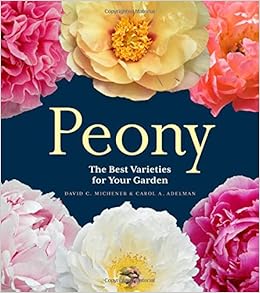
Dr. David C. Michener, is the Associate Curator for the University of Michigan Matthaei Botanical Gardens and Nichols Arboretum and has written a comprehensive book about peonies for home gardeners if your are interested in learning more. He oversees the largest public collection of historical herbaceous peonies in North America. Dr. Michener and Carol Adelman, a grower of over 400 peony varieties in Oregon, collaborated on this book, which is now included on The New York Times Summer Reading List.


The American Peony Society


Resources__________________________________________________
  • Carsten Burkhardt's Web Project Paeonia   www.paeon.de
  • Van Wert, Ohio Peony Festival
  • https://www.gardenia.net/plants/plant-family/paeonia_--_peonies
  • Hidden Springs Flower Farm PO Box 602 18581 County Road 4, Spring Grove, MN 55974 (763) 218-4540
  • http://www.southernpeony.com/2016/01/2016-peony-on-my-wish-list-silvia.html
  • Plants Delight Nursery (testing peonies that will thrive in the south)
  • https://www.whiterabbitinstituteofhealing.com/herbs/peony/


 ____________________________________________________________________________________
 _____________________________________________________________________________________

Wednesday, September 15, 2021

'Stayman's Winesap' Apple

______________________________________________________
_____________________________________________________


'Stayman's Winesap' Apple 
(Malus domestica)

Dr. Joseph Stayman  (1817-1903). The Stayman’s winesap apple was developed in 1866 and sold by nurseries from 1895.  Dr. Stayman grew up in Cumberland County, Pennsylvania and practiced medicine but eventually gave that up to instead pursue experimenting with the growing habits of fruits like apples and strawberries. He played an integral role in establishing the Kansas State Horticultural Society also in 1866, having left Pennsylvania several years earlier.In 1866 He left the practice of medicine at an early age to specialize in horticultural research and experimentation, developing numerous varieties of apples, strawberries, and grapes in his Kansas orchards. He experimented with grafting fruit trees and at one time had an apple tree which bore sixteen varieties, the result of multiple grafting. As a result of forty years experience in growing apples in Kansas, Dr. Stayman recommended the following as the four best varieties for the state: Stayman's Winesap, York Imperial, Jonathan and White Pippin. Dr. Stayman studied the drawing of fruit varieties, and his sketches were regarded as extremely precise. These sketches were given to the Smithsonian Institution. I have as yet not found an electronic link but other Malus illustrations can be found at the USDA Pomological illustrations


References_______________________________   
  1. Bente, H F. New Apple Magnate: History and Testimonial of the Magnate. Leavenworth, Kan: Bente Nurseries, 1916. Print.  
  2. https://www.albemarleciderworks.com/orchard/apple/stayman-winesap 
  3. A Tribute to the Stayman-Winesap, Wolffe's Apple House, Media, Pennsylvania.
  4. NY Public Library, Malus botanical art.
  5. PlantsIllustrated, Malus botanical art. 
  6. Bussey, Daniel J, and Kent Whealy. The Illustrated History of Apples in the United States and Canada. , 2016. Print.


The Illustrated History of Apples in the United States and Canada (7-Volume Set)

By: Daniel J Bussey, Kent Whealy
 3500 pages, 1400 colour illustrations
Publisher: Jak Kaw Press
This book is the result of 30 years of research and seven years of editing. The lavishly illustrated hardcover set of seven volumes comprehensively documents all apple varieties that have appeared in publications in the United States and Canada through the year 2000.

- 16,350 varietal listings (descriptions, origins and histories)
- 9,700 synonyms (other names the apples were known by in different locations)
- 1,650 cited references (two centuries of pomological literature on apples)
- 1,400 life-size watercolors (painted a century ago for color documentation)

This unprecedented compendium is the result of a collaborative effort between Daniel J. Bussey and Kent Whealy. For 30 years, whenever time allowed, Dan Bussey has searched countless libraries for everything published about apples during the last two centuries in the United States and Canada. Dan’s research has identified information about apples in 1,650 pomological publications, which he compiled into 16,350 varietal listings and 9,700 synonyms.

For the last seven years, Kent Whealy has been editing Dan’s extensive research and notes. The seven volumes that Kent designed include the most complete cataloging of the pomological literature on apples ever compiled. In addition, from 1886-1942 the USDA employed 21 artists to paint 7,584 watercolors of 38 families of fruits, including 3,820 apples. USDA’s Pomological Watercolor Collection provided documentation before colour photography existed and is a little known national treasure. Over 1,400 of these beautiful paintings are included as illustrations, in order to create an unprecedented identification tool for apple sleuths searching for lost varieties.
Apples documented in pomological publications, horticultural and pomological society proceedings, governmental and experiment station bulletins, and commercial nursery catalogs through the year 2000."
"Historic watercolors from the archives of the National Agricultural Library, Special Collections."

Council on Botanical and Horticultural Libraries (CBHL) Annual Literature Award, 2018
7 volumes : color illustrations ; 28 cm

v. 1. A-B --
v. 2. C-F --
v. 3. G-K --
v. 4. L-N --
v. 5. O-R --
v. 6. S-V --
v. 7. W-Z

.


©  Grassroots Horticulture
2014
________________________________________________________________________________
________________________________________________________________________________

POMOLOGISTS | BIVORT


Bivort was born at Fleurus on 9 March 1809. He was educated at the industrial school in Melle and at the college in Aalst, where he graduated secondary school at the age of fifteen. While working in the family coal business at Jumet, he devoted much of his time to the study of agriculture, eventually becoming a full-time horticulturalist. In 1840 he acquired the seed collection of Jean-Baptiste Van Mons, numbering about 20,000 seeds, and gradually transported it to his own property at Saint-Remy-Geest.  In 1854 he became the director of the Société Van Mons.  He corresponded with many leading international pomologists, and was the secretary of the editorial committee of the Commission Royale de Pomologie's Annales de pomologie belge et étrangère (1853–1860), to which he was a substantial contributor. He died in Fleurus on 8 May 1872.Album de pomologie (4 vols., 1847–1850). His study and writings about pears has added to a historical understanding of the fruit.

Friday, October 25, 2019

Old Gardening Books Worth a Look

Copyright law can be a bit tricky but generally, often after 70 years books lose the copyright that protects the author. Works published after 1923, but before 1978 are protected for 95 years from the date of publication. Often the books are "dated" but they are just as often worth a thorough perusal with the caveat, that cultural practices could be "dated". If you have always disliked wasps, reading Wasps and Their Ways could give you a better understanding of why God put them here with us.  Here are a few gardening books available electronically from Kellcraft Studios.


  • American Flower Garden, The. Neltje Blanchan. NY: Doubleday, Page and Company. 1909.     Arts and Crafts period in NY.  Chapters include: Vines, Roses, Annuals, Garden Furniture, etc.

  • The Life of the Bee.  Maurice Maeterlinck. Translated by Alexander Teixeira Mattos. New York: Dodd, Mead and Company. 1910.
  • The Double Garden. Maurice Maeterlinck. Translated by Alexander Teixeira Mattos. New York: Dodd, Mead and Company. 1911
  • Dutch Bulbs. Una Silberrad and Sophie Lyall.  Illustrations by Mima Nixon.  London: Adam and Charles Black. 1909.
  • Island Garden, An. Celia Thaxter. Illustrated by Childe Hassam. Boston: Houghton Mifflin Co. 1894.
    

Saturday, April 1, 2017

Historically Significant Gardens | Monticello

__________________________________________________________________________


Perusing through statistics for a blog I have about genealogical pursuits a significant number stood out. People were very interested in Thomas Jefferson's family, more so than any of the other Presidents genealogy I have researched and posted. 

In 1998 we took a family trip to see Williamsburg, Mt. Vernon, and Monticello. What captured our curiosity was not only the beauty of the Blue Ridge Mountains but the significant difference in the philosophical style of gardening between Washington and Jefferson. Jefferson sited Monticello at the top of the mountain, more for a view than a productive farm. Mt. Vernon was a working farm, not just subsistence but to bring in additional monies. Included were smoke houses and working quarters, adjacent to it's ideal location on the Potomac to provide irrigation and shipping.


Gardening + History

A pleasant notification greeted me last week from Margaret Roach's blog, A Way to Garden. She was hosting, Peggy Cornett, Historic Gardener and Curator of Plants at Jefferson’s former home, and they were discussing lettuces and beans of the Jefferson varietyGardening plus history is my kind of equation. So, to get an early start on the President's Day Festivities I hope you visit her site and celebrate the knowledge she shares about his gardening.

President's Day
Some of my earliest memories of cold days in January were helping my Grandmother, a second grade teacher, cut out construction paper silhouettes of the Presidents for her bulletin boards. I would usually trace and she would cut. I think Thomas Jefferson had a braid with a bow, along with that patrician nose that defined his countenance. 


His Calender and Journal
Thomas Jefferson's Garden Journal (or manuscript) is available at the Massachusetts Historical Society in Boston. It includes notes from his family's garden at Shadwell. He lists scarlet beans as one of the seeds included in their plantings. We planted scarlet runner beans this morning. I know it is too early but last year we planted them late and only had a few blooms before the heat of the summer dried it's marathoning spirit. 


A Favorite Coffee Table Book
One of my favorite books is Jefferson's Monticello by William Howard Adams. There are photographs of some of the ingeniously designed, seven-day calendar clock and polygraph along with sketches of garden designs and the important people responsible for maintaining the estate.

What stuck with me the most about Monticello was the air seemed to be more pure than anywhere I have ever been and the view would take your breath away.

So, here is the most visited post from my genealogy blog:

Presidential Genealogy | 3 | Thomas Jefferson (1743-1826)


$Brick Walls, Charts, Critical Analysis, Family Stories, Genealogical Writing, Maps, Object Lessons,
 Research Methods and Tips


Descendants of Thomas Jefferson

1   Thomas Jefferson 1675 - b: Abt. 1675
.. +Mary Field 1675 - b: Abt. 1675
...... 2   Peter Jefferson 1707/08 - b: February 29, 1707/08 in Chesterfield County, Virginia
........... +Jane Randolph 1720/21 - 1776 b: February 09, 1720/21 in Shadwell, 
Tower Hamlets, London, d: March 31, 1776

.............. 3   Thomas Jefferson 1743 - 1826 b: April 13, 1743 in Shadwell, Virginia d: July 04, 1826 in 
Charlottesville, Virginia, U.S./College of William and Mary
.................. +Martha Wayles d: in The Forest (her father's plantation)
...................... 4   Martha Washington Jefferson 1772 - b: September 27, 1772
.......................... +Thomas Mann Randolph 1770 - b: Abt. 1770
.............................. 5   Eleanora Wayles Randolph 1800 - b: Abt. 1800
.................................. +Joseph Coolidge
...................................... 6   Thomas Jefferson Coolidge 1831 - b: 1831
.......................................... +Mehitable Sullivan Appleton
............................................... 7   Marion Appleton Coolidge
............................................... 7   Eleanora Randolph Coolidge
............................................... 7   Sarah Lawrence Coolidge
............................................... 7   Thomas Jefferson Coolidge
...................... 4   Jane Randolph Jefferson
...................... 4   Peter Jefferson
...................... 4   Mary "Polly" Jefferson
...................... 4   Lucy Elizabeth Jefferson
.............. 3   Jane Jefferson 1745 - b: Abt. 1745
.............. 3   Mary Jefferson 1741 - b: 1741
.............. 3   Elizabeth Jefferson 1744 - b: 1744
.............. 3   Martha Jefferson 1745 - b: Abt. 1745
.............. 3   Peter Field Jefferson 1745 - b: Abt. 1745
.............. 3   Peter Thomas Jefferson 1745 - b: Abt. 1745
.............. 3   Lucy Jefferson 1752 - b: October 10, 1752
.................. +Charles Lilburn Lewis 1747 - b: 1747

Peter Jefferson (February 29, 1708 – August 17, 1757) was the father of
 US President Thomas Jefferson (1743–1826). A surveyor and cartographer, his Fry-Jefferson Map of 1751
 accurately depicted the Allegheny Mountains for the first time and showed the route of
 "The Great Road from the Yadkin River through Virginia to Philadelphia distant 455 Miles" —
 what would later come to be known as the Great Wagon Road.


Explore Further:

Article:  Reclaiming Jefferson's Monticello, Elizabeth Hutchinson