Showing posts with label Garden palettes. Show all posts

Tuesday, November 1, 2022

In Monet's Garden | Giverny, France

True Art Consists in Idealizing, and not copying, the forms of nature.
Pink Water Lilies
Monet, inspired by techniques he found in Japanese art, and groomed by Renoir, he idealized nature and landscapes following fixed laws; the proportionate distribution of areas, the tangential curvature of lines, and the radiation from a parent stem, and created in 1873, Impression Sunrise, the painting for which the entire Impressionist movement was named.


Monet - Impression, Sunrise.jpg
Impression Sunrise 1873
Musée Marmottan Monet, Paris

His house was filled with Japanese wood block prints. Japanese art and culture played an important role in his vision of the ideal in nature. Claude Monet's collection is composed of forty-six prints by Kitagawa Utamaro (1753-1806), twenty-three by Katsushika Hokusai (1760-1849) and forty-eight by Utagawa Hiroshige (1797-1858), that is to say one hundred and seventeen out of the two hundred and eleven exhibited, plus thirty-two prints held in reserve.


Light and shadow 
Monet and the Japanese artists used the research technique of “serie”. The artists captured the same motif, at different times of the day.
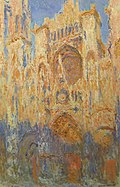


Monet's garden


White Water Lily
Monet's lilies were a conception for a limited palette applied with rapid brushstrokes, using lead white, cadmium yellows, vermilion, red alzarian lake, cobalt blue, cobalt violet, viridian green, ultramarine blue, emerald, and chrome.


Pendulous White Flowers


Monet's palette 
Musee Marmottan Monet, Paris, France,
 Giraudon The Bridgeman  Art Library 


The Dallas Museum of Art had an exhibition named, 
The Fifty-Three Stations of the Tōkaidō
It is an exhibit of 53 Japanese woodblock prints illustrating village stops along a route through the mountains from Edo to Tokyo. We have 4 woodblock prints by Hiroge Yoshito and now I understand why they are called "part of the travel series". Each village was known for a certain part of their culture. Several villages were market towns, one village was known for tie-die, there were those beautiful arched bridges, one village was a red light district, Mt. Fuji is featured in many, Buddhist and Shamin Temples have that pagoda-like architecture, and there is even a mountain pass known for thieves. I cannot remember any of the village names but the exhibit was helpful to my understanding. We went to the Claude Monet house and garden in Giverney, France in 2000 and the interior of his house was filled with Japanese woodblock prints. His art was inspired by all the woodblock prints he found. It is fascinating to me, to put all this together. 
______________________________________________

 Here are a couple of my woodblock prints.
Misty Day in Nikko

                               Temple in the Wood


Hiroshi Yoshida (吉田 博 Yoshida Hiroshi, September 19, 1876 – April 5, 1950) was a 20th-century Japanese painter and woodblock printmaker. He is regarded as one of the greatest artists of the shin-hanga style, and is noted especially for his excellent landscape prints. Yoshida travelled widely, and was particularly known for his images of non-Japanese subjects done in traditional Japanese woodblock style, including the Taj Mahal, the Swiss Alps, the Grand Canyon, and other National Parks in the United States.
Hiroshi Yoshida (born Hiroshi Ueda) was born in the city of Kurume, Fukuoka, in Kyushu, on September 19, 1876.[1] He showed an early aptitude for art fostered by his adoptive father, a teacher of painting in the public schools. At age 19 he was sent to Kyoto to study under Tamura Shoryu, a well known teacher of western style painting. He then studied under Koyama Shōtarō, in Tokyo, for another three years.
In 1899, Yoshida had his first American exhibition at Detroit Museum of Art (now Detroit Institute of Art). He then traveled to Boston,Washington, D.C., Providence and Europe. In 1920, Yoshida presented his first woodcut at the Watanabe Print Workshop, organized byWatanabe Shōzaburō (1885–1962), publisher and advocate of the shin-hanga movement. However, Yoshida's collaboration with Watanabe was short partly due to Watanabe's shop burning down because of the Great Kanto earthquake on September 1, 1923.

In 1925, he hired a group of professional carvers and printers, and established his own studio. Prints were made under his close supervision. Yoshida combined the ukiyo-e collaborative system with the sōsaku-hanga principle of "artist's prints", and formed a third school, separating himself from the shin-hanga and sōsaku-hanga movement.
Hiroshi Yoshida was trained in the Western oil painting tradition, which was adopted in Japan during the Meiji period. Yoshida often used the same blocks and varied the colour to suggest different moods. The best example of such is Sailing Boats in 1921. Yoshida's extensive travel and acquaintance with Americans influenced his art considerably. In 1931 a series of prints depicting scenes from India, Pakistan, Afghanistan, and Singapore was published. Six of these were views of the Taj Mahal in different moods and colors.


Bibliography_____________________________________
  1. Claerhout, François, Claude Monet, L’œil et le monde, les Années à Giverny : 1883-1926,  2005
  2. Leuck, Krista, Claude Monet’s Japanese Print Collection, 13 April 2007.
  3. Echaubard, Laurent, La collection d’estampes japonaises 
  4. Cauderlier, A., Monet’s collection of Japanese WoodBlocks, 14 April 2006 [Online] Available : http://www.intermonet.com/japan/ 
  5. Aloi, Giovanni, what other's Don't tell you about Monet's Waterlilies. 
  6.   (https://youtu.be/Kj56NGwjdlc)
  7.  

     Why look at plants? : the botanical.                emergence in contemporary art / written and edited by Giovanni Aloi.
  8. Leiden ; Boston : Brill Rodopi, [2019]
  9. Japanese Woodblock Print Information


© 2023 Grassroots Horticulture

__________________________________________________________________________________________________
http://www.visual-arts-cork.com/artist-paints/colour-pigments.htm

Tuesday, April 13, 2021

THEMED GARDEN | ARTIST VAN GOGH


The artist, Vincent van Gogh, after another disappointment in trying to establish an artist colony in the south of France, settled shortly in Saint-Remy-de-Provence where he continued to paint nature and express his emotional angst and suffered the possible side effects to the chemistry of lead and ill health that came to some artists of this era. It's amazing how many of the older pigmentswere highly toxic compounds containing lead, mercury, chrome, arsenic - even cyanide. 


Saint-Rémy-de-Provence, France 
Migration, wars and population expansion brought people with their cultures and values and each affected the ecosystem in this Mediterranean climate. Romans built roads and irrigation networks. Greeks brought the cultivation of vines and olives for sustenance and commerce. In this very sunny, 300 days out of 365 days, and limestone environment a unique nature flourishes. 


Plants of Provence and The Five Senses
Plants of St. Remy de Provence
The essential oils of the lavender, roses, angelica, and verbena of Provence are synonymous with essence and perfume. Herbes de Provence, the mixture of savory, fennel, thyme and lavender flowers is used in haute cuisine and the flavoring or soups and sauces.


Using the herbs of Provence

Herbes de Provence are used to flavour grilled foods such as fish and meat, as well as vegetable stews. The mixture can be added to foods before or during cooking or mixed with cooking oil prior to cooking so as to infuse the flavour into the cooked food. They are rarely added after cooking is complete.

Ingredients

  • 2 tablespoons dried basil
  • 2 tablespoons dried fennel seed 
  • 2 tablespoons dried marjoram
  • 2 tablespoons dried oregano
  • 2 tablespoons dried rosemary   
  • 2 tablespoons dried savory
  • 2 tablespoons dried thyme
  • Directions:
  • In a mixing bowl, combine all the ingredients. Store in an air-tight container.
___________________________________________________

There is a peaceful bucolic quality that many would find beautiful and inspiring here. This is where van Gogh painted.

Saint-Paul Asylum, Saint-Rémy-de-Provence


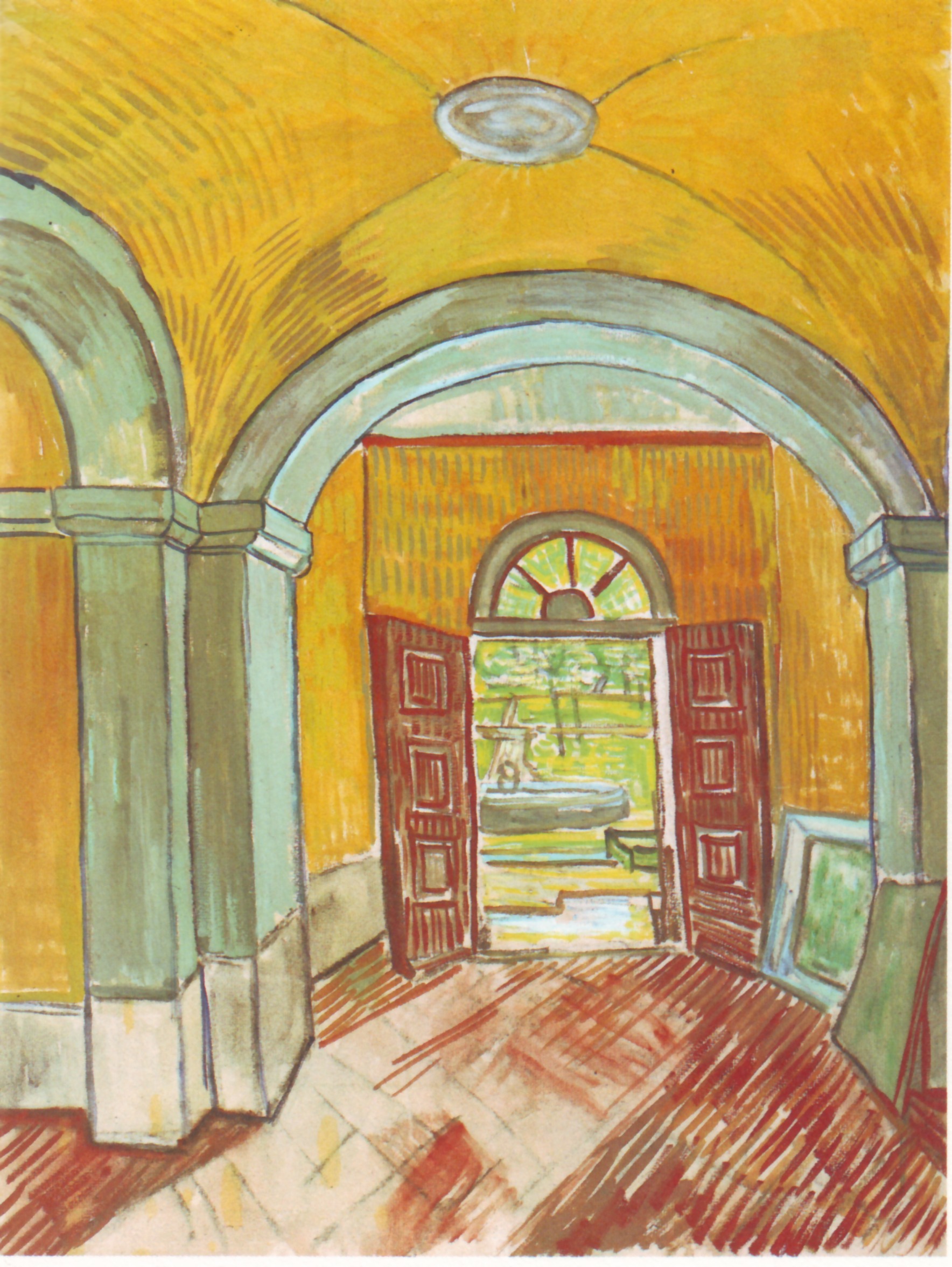
Entrance Hall of Saint-Paul Hospital Van Gogh Provence paintings
Entrance Hall of Saint-Paul Hospital (Van Gogh Museum, Amsterdam)
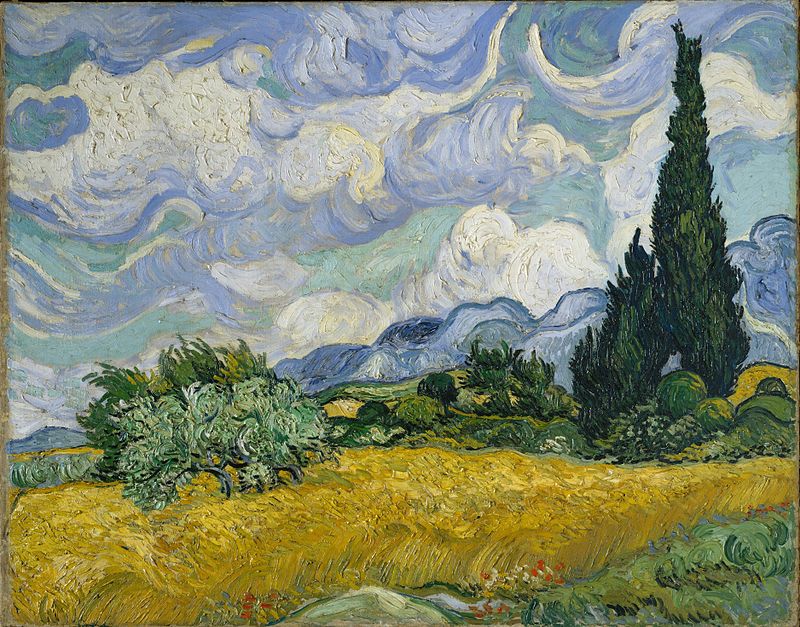
Van gogh life in provence paintings st remy de provence
A Wheatfield with Cypresses, a painting inspired by the view from van Gogh's window at Saint-Paul-de-Mausole mental asylum, toward the Alpilles mountains (Metropolitan Museum of Art, New York)
We approached the painter in this photograph and asked in French, "Pouvons nous prendre votre photo, May we take your picture?" "Yes," she was from Kansas.

 
An artist painting in the meadow at St. Paul Hospital, Saint-Rémy-de-Provence, France


Saint-Rémy-de-Provence, France and Vincent van Gogh

On May 8, 1889, van Gogh committed himself to the hospital at Saint Paul-de-Mausole. The hospital was a former monastery in Saint-Rémy. The monastery is located in an area of Grain fields, vineyards and olive trees. Vincent's brother, Theo, arranged for two small adjoining rooms, with barred windows. The second room was his studio.

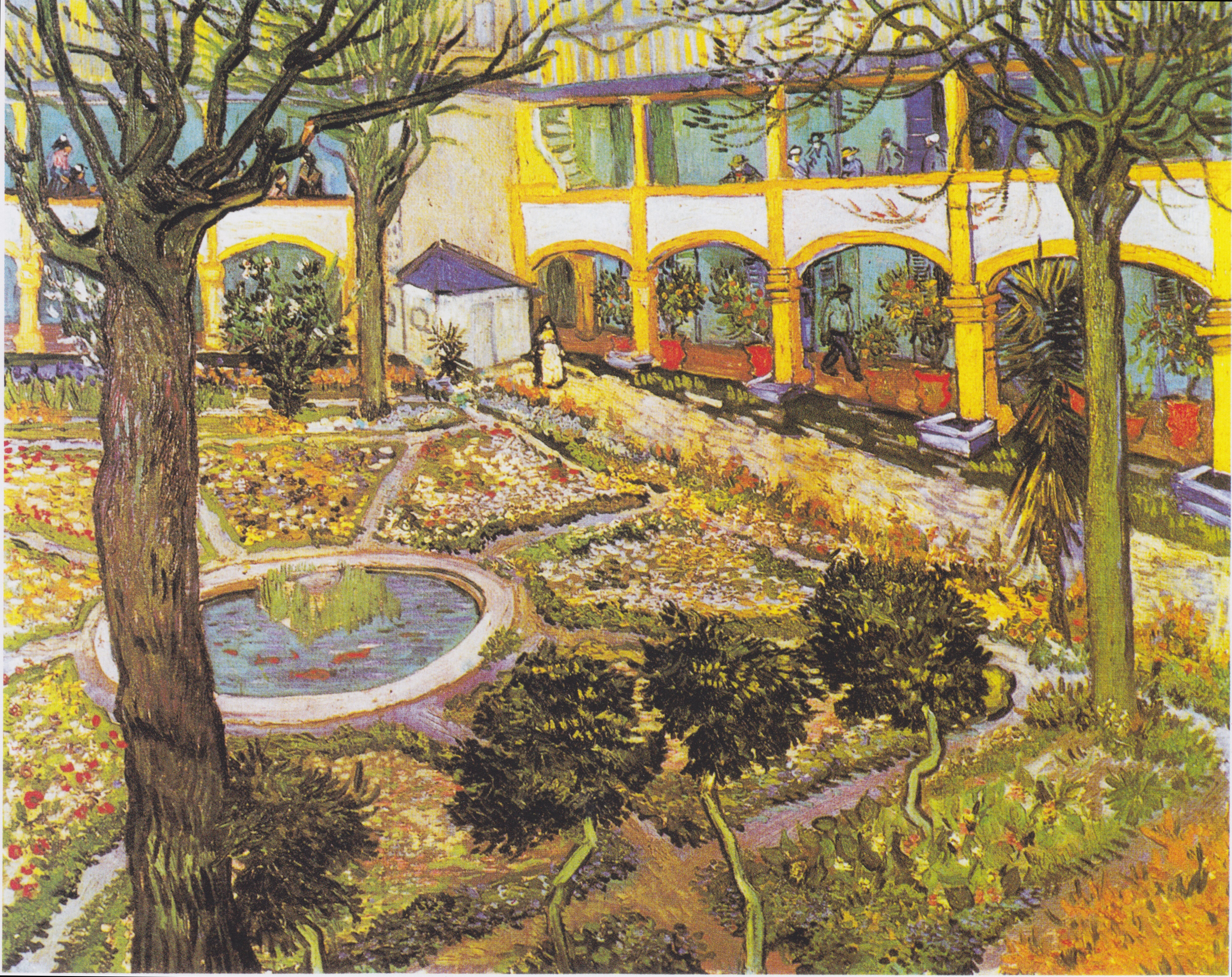
Van Gogh Hospital, Arles, Van Gogh Provence
The garden of the hospital in Arles (Oskar Reinhart Collection, Winterthur, Switzerland)

A man playing a popular game, Petanque, in Saint-Rémy-de-Provence

A painting of a scene at night with 10 swirly stars, Venus, and a bright yellow crescent Moon. In the background there are hills, in the middle ground there is a moonlit town with a church that has an elongated steeple, and in the foreground there is the dark green silhouette of a cypress tree and houses.

A painting of a scene at night with 10 swirly stars, Venus, 

and a bright yellow crescent Moon. 
In the background there are hills, in the middle ground there is a moonlit town 
with a church that has an elongated steeple, and in the foreground there is the dark green silhouette of a cypress tree and houses.


_________________________________________________________________________

Sunday, March 21, 2021

Palettes | A Renoir Palette


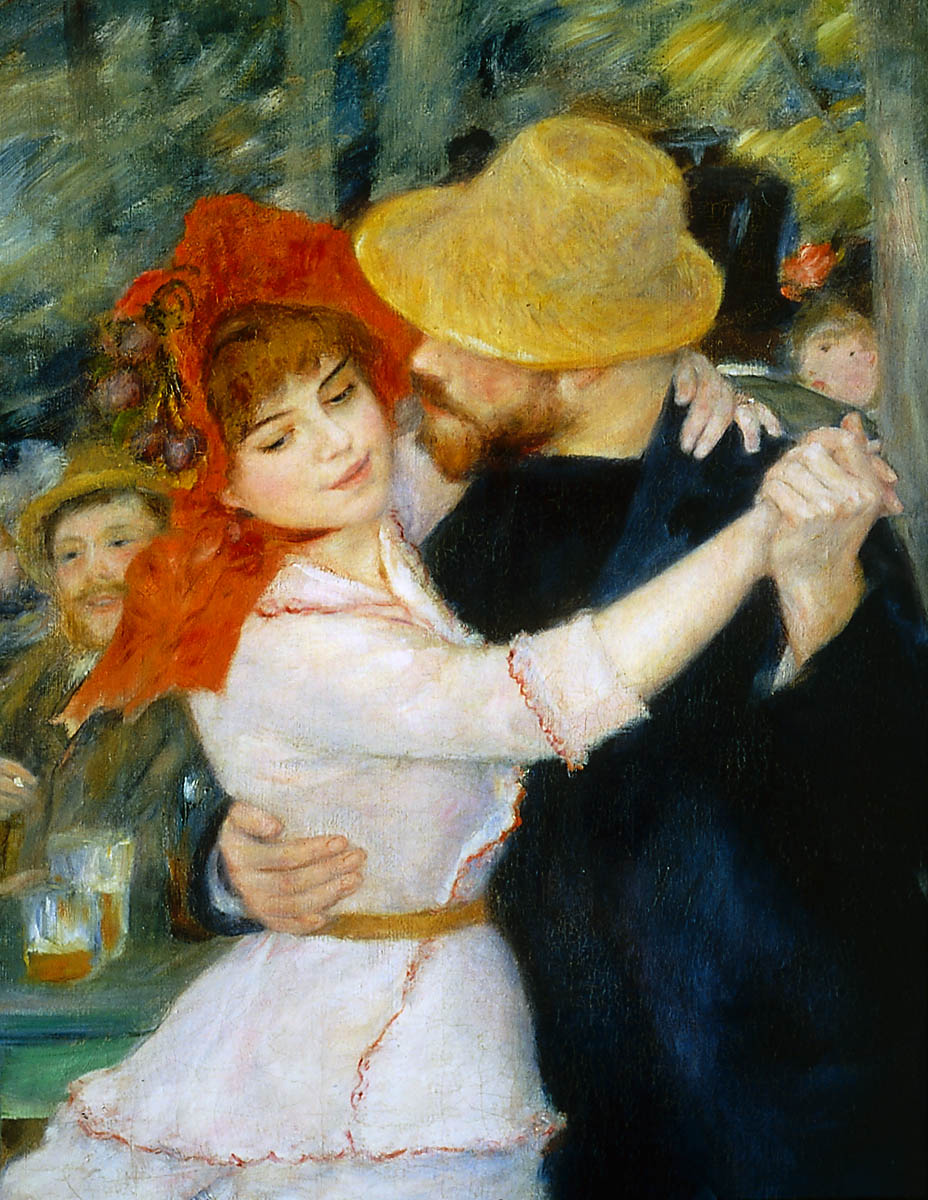
Rachelle Greayer’s book, Cultivating Garden Style, introduces the concept of using art for inspiration in your garden. I have been using the palette of Renoir's Dance at Bougival and the Texas spring prairie.

Museum of Fine Arts, Boston


  NAPLES YELLOW     

  CHROME YELLOW


  VERMILLION

  ALIZARIN CRIMSON

  FRENCH ULTRMARINE BLUE

  COBALT BLUE


  VERIDIA N

  EMERALD GREEN

  LEAD WHITE


Spring Prairie Palette
My mother gave me a beautiful basket and I filled it with bluebonnets and Indian paintbrush so I can have the colors of the Texas spring prairie throughout the year in my home.


In My Garden

In my garden the blue larkspur and bluebonnets dance in the spring breeze and later in the season the reds of the hummingbird bush, salvias and turks cap dance with the hummingbirds.


Another grouping is blackfoot daisy, dahlburg daisy, Denver dream miniature rose, and blue fescue. I am looking for a replacement for the blue fescue but otherwise this perennial rock garden does well in full sun. I am a big fan of miniature roses because they do not require as much attention as my other roses.


Fall Garden

My fall Renoir palette garden is for the hummingbirds. It includes hummingbird bush (Anisacanthus quadrifidus var. wrightii), pineapple sage, Texas sage, and turk's cap. I am looking for a good blue to include in this grouping.


The photograph below is a fall blue and red combination of salvias in a bed for pollinators.


Red | Texas Sage (Salvia coccinea)


A Lovely Dance in the Tearoom 

My daughter and I meet for lunch at the Dallas Arboretum Tearoom and enjoy the garden throughout the year. The room has a white adobe wash on the fireplace, white and blue on the tables and Chinese porcelain, and silver serving pieces along the walls in display cases. Clearly, the palette of the dancing pair. Japanese woodblock prints and the cobalt blue and white of the chinaware made a deep and lasting impression on the artists of The Impression Era.


Tuesday, April 24, 2018

Woodland Shades | Organic Neutrals

___________________________________________________
__________________________________________________

Woodlands | Organic Neutrals

Shades of browns and beiges in a woodland carpet 


                                Grecian windflower,  Anemone blanda            


Deconstructed woodland floor colors with purple/blue Grecian windflower


Pasque flower, Anemone pulsatilla


Sometimes, I photograph a plant in nature that has an outstanding texture, that might facilitate a use for interior design. I found this fluffy Pasque flower, going to seed, and loved the texture so much, that I put the photograph through changes and tried a cut-out artistic technique, to see if any might make a fabric design for a chaise on my patio. Here is my Warhol-esque board to view. 


Organic Neutral Shades
I am not writing about the anemone "flower" here. but adding to a study of neutrals.  I have been studying neutral colors, trying to deconstruct landscape photographs to understand color shades and hues and how other colors work together in a composition. I like this color compass from Country Living magazine


Organic Neutral

Beige | Gray | Taupe | Mushroom |  Latte 

I saw this color chart and thought, this is a great all-in-one solution to visually explain the gentle nuances in a neutral color pallette.


All material © 2007-2018 by Jeanette Hyden for Grassroots Horticulture
_____________________________________________________________________________________________________________________________________
______________________________________________________________________________________________________________________________________