Showing posts with label color. Show all posts

Wednesday, March 16, 2022

NATURE JOURNALING AND BOTANICAL DRAWING


Laws, John M, and Emilie Lygren. 
The Laws Guide to Nature Drawing and Journaling. , 2016. 

THE ultimate guide to nature drawing and journaling! A potent combination of art, science, and boundless enthusiasm, the latest art instruction book from John Muir Laws (The Laws Guide to Drawing Birds) is a how-to guide for becoming a better artist and a more attentive naturalist. In straightforward text complemented by step-by-step illustrations, dozens of exercises lead the hand and mind through creating accurate reproductions of plants and animals as well as landscapes, skies, and more. Laws provides clear, practical advice for every step of the process for artists at every level, from the basics of choosing supplies to advanced techniques. While the book's advice will improve the skills of already accomplished artists, the emphasis on seeing, learning, and feeling will make this book valuable--even revelatory--to anyone interested in the natural world, no matter how rudimentary their artistic abilities."--ProQuest.  

Focused observation—drawing, sketching, and writing—changes how we look at the world around us. Nature journaling forces us to see, instead of look. 


SUPPLIES

WHAT IS THE BEST NOTEBOOK FOR JOURNALING?

High-quality notebooks tend to be favorites for everyday journaling. You can always start with what you have on hand (I’m looking at you, stationery stashers!), but it’s a good idea to invest in something that won’t fall apart. I’m exceptionally picky about notebooks, and with good reason. It’s the actual journal, after all!

I had a really hard time picking a favorite brand of notebook, but I have 3 brands I would order again without hesitation. In the photo above, I have a Rhodia Goalbook Scribbles That Matter Pro (middle), and an A5 Leuchtturm1917. The Leuchtturm1917 was my first love, but it ghosts a bit more than the other two versions. The Rhodia has the best paper, hands-down, but it’s a soft cover and has more ivory paper. The Scribbles That Matter is my new love, but the color choices may be a bit bold for some people.

The one you pick really depends on your preference. Ghosting doesn’t really bother me, but some people can’t stand it. Ivory colored paper can be quite soothing, but some people prefer bright white. Honestly, any of these 3 notebooks will serve you well. There’s a reason I couldn’t pick just one favorite!

Moleskine items are designed in Italy with most of them being printed, stitched, and assembled in China. Since 2008, some components have been manufactured in Volant, Cahiers and Folio hard covers in Turkey, watercolour paper in France, and some components in Vietnam. The paper used in Moleskine products is Forest Stewardship Council certified and acid-free. Since August 2010, all Moleskine products, offered to retailers in California and throughout the world, comply with the Safe Drinking Water and Toxic Enforcement Act of 1986. After concerns in 2008 about PVC traces in some notebooks, all items are now PVC-free.

Created with the nature journalist in mind, The Laws Sketchbook for Nature Journaling hardcover blank journal is the perfect starting point for anyone interested in the practice and joy of getting out, observing, and recording nature

Picadilly is widely available.


WHAT ARE THE BEST PENS FOR JOURNALING?

If you ask 20 people about the best pen for journaling, you’re sure to get 20 different answers. In my opinion, fine felt-tipped pens (artist pens) are ideally suited for everyday doodling, drawing layouts, creating tasks lists. They’re my absolute go-to pens for all my journal-writing needs. Sure, I love a good fountain pen, but they don’t give me the effect I want when using stencils, against a ruler, or for sharp doodled lines. I’ve started reserving my fountain pens for fast note-taking and letter writing.

have a whole jar full of artist pens. There are so many trustworthy companies making these now that I could devote an entire post to comparing them. Instead, I’ll just mention the ones I reach for again and again. Sharpie pens (PENS, not markers. If you get fine-tipped permanent markers, they will bleed through your journal pages) are always floating around my house. They’re easy to find,  even in bulk. My absolute favorite pens are the Tombow Mono Drawing Pens, but they’re more expensive and harder to find. Pigma Microns are also a great option. They come in an assortment of sizes, and since they use archival ink, you can use them for a variety of other purposes.

The Zebra Zensations This pen is a key part to a journal kit. You can vary the pressure to change the strength of my line. The ink is water resistant, acid free, and archival quality. 


WHICH COLORED PENS and pencils ARE BEST FOR JOURNALING?

have so many colored pens, but I only use two sets with any regularity. Again, you can’t go wrong with either one of these sets. I go back and forth between them, but either one would fulfill all of my journaling needs!

My Staedtler Fineliners (at the bottom of the picture below) are so beloved that I upgraded from my 10-pack to the 42-color set. I’ve gotten a lot of use out of them, and I love having so many colors at my fingertips. They’re very fine, which gives you a lit of control over where the color goes.

Out of sheer curiosity, I also picked up the Tombow TwinTones as soon as they were released. As a general rule, I love Tombow products, so I knew I had to try them!  I keep the TwinTones on my desk, and I reach for them daily. These are double-ended planner pens, so  each pen has 2 tip sizes to choose from.  They come in 2 different sets (Brights and Pastels), so you would need to buy them both to get a full spectrum of colors. Compared with the Staedtlers, this ends up being the more expensive option, but the double tips also offer some extra versatility.

Faber-Castell Artists’ Color Pencils Polychromos Pencils are high quality pencils made in Germany. 

Prismacolor Copy-Not Col-Erase non-photo blue pencil #20028 can be used to make ghost lines.

ACCESSORIES AND TOOLS FOR JOURNALING

A ruler may be the only drawing tool you ever use. I’ve always liked the clear Westcott rulers because they make it easy to keep things centered. A small ruler fits easily in the back of the journal (especially if it has a pocket), but I also keep a longer ruler for making layouts at home. A 12-inch ruler (mine is a Westcott B-70) is long enough that I can create lines across two pages at once. It saves a lot of time!

Circle Tools

I got by with a simple little ruler for over a year! I never used any stencils or tools, and if I needed to make a circle, I traced a glass or bottle cap. That was great for keeping my supplies in check, but I really wanted a better tool for making circles. I bought at least 4 different (horrible) compasses on Amazon before I stumbled upon the circle and helix maker (pictured above). I had no idea how it would work, but I took a chance. Holy moly! Besides a good notebook, my circle maker is probably the best journal-related purchase I’ve made! It’s so each to make a circle exactly the right size. I know, I sound like a crazy protractor lady! But it’s the tool I get asked about the most, and I recommend it more than any other. There’s nothing else like it.

  1. An art journal
  2. Gesso
  3. Paint (acrylic or watercolor)
  4. Brushes
  5. Pens & Pencils
  6. Paper
  7. Stamps & Inks
  8. Stencils

Ball, Philip. Patterns in Nature: Why the Natural World Looks the Way It Does. , 2021. 

Though at first glance the natural world may appear overwhelming in its diversity and complexity, there are regularities running through it, from the hexagons of a honeycomb to the spirals of a seashell and the branching veins of a leaf. Revealing the order at the foundation of the seemingly chaotic natural world, Patterns in Nature explores not only the math and science but also the beauty and artistry behind nature's awe-inspiring designs. Unlike the patterns we create in technology, architecture, and art, natural patterns are formed spontaneously from the forces that act in the physical world. Very often the same types of pattern and form - spirals, stripes, branches, and fractals, say--recur in places that seem to have nothing in common, as when the markings of a zebra mimic the ripples in windblown sand. That's because, as Patterns in Nature shows, at the most basic level these patterns can often be described using the same mathematical and physical principles: there is a surprising underlying unity in the kaleidoscope of the natural world. Richly illustrated with 250 color photographs and anchored by accessible and insightful chapters by esteemed science writer Philip Ball, Patterns in Nature reveals the organization at work in vast and ancient forests, powerful rivers, massing clouds, and coastlines carved out by the sea. By exploring similarities such as those between a snail shell and the swirling stars of a galaxy, or the branches of a tree and those of a river network, this spectacular visual tour conveys the wonder, beauty, and richness of natural pattern formation.
CHAPTER 1. SYMMETRY --
CHAPTER 2. FRACTALS --
CHAPTER 3. SPIRALS --
CHAPTER 4. FLOW AND CHAOS --
CHAPTER 5. WAVES AND DUNES --
CHAPTER 6. BUBBLES AND FOAM --
CHAPTER 7. ARRAYS AND TILING --
CHAPTER 8. CRACKS --
CHAPTER 9. SPOTS AND STRIPES --


References.                                                  
PINTEREST  https://pin.it/4Q4rQ4t
Bibliography
subject: botanical art - technique; nature - journal
  • Baines, Valerie. Botanicals: Secrets of Observational Drawing. , 2017. Print.
  • Guner, Isk, and Ekin Ozbicer. Botanical Illustration from Life: A Visual Guide to Observing, Drawing and Painting Plants. , 2019. Pri
  • Laws, John M, Amy Tan, and Emilie Lygren. How to Teach Nature Journaling: Curiosity, Wonder, Attention. , 2020. Print. Teaching NatureJournaling.  https://johnmuirlaws.com/teach-nature-journaling-video-workshop/
  • Laws, John M. The Laws Guide to Nature Drawing and Journaling. , 2016. Print.
  • Martin, Rosie, and Meriel Thurstan. Exotic Botanical Illustration: With the Eden Project. London: Batsford, 2012. Print.
  • Leslie, Clare Walker, Charles Edmund Roth, and Edward O. Wilson. Keeping a Nature Journal: Discover a Whole New Way of Seeing the World Around You. 2003.
  • Thurstan, Meriel, and Rosie Martin. Botanical Illustration for Beginners: A Step-by-Step Guide. , 2015. Internet resource.
  • Tomlinson, Susan L. How to Keep a Naturalist's Notebook. Mechanicsburg, PA: Stackpole Books, 2010. Print
  • Wheelwright, Nathaniel T, and Bernd Heinrich. The Naturalist's Notebook: An Observation Guide and 5-Year Calendar-Journal for Tracking Changes in the Natural World Around You. , 2017. Print.
  • Hazel Wilks, Kew Gardens: https://youtu.be/JqQDp9VnDAk
  • https://www.botanicalartandartists.com/botanical-artists-in-the-uk.html
  • Taggert, Emily, The History of Botanical Illustration. The Met.
  • https://mymodernmet.com/history-of-botanical-illustration/ 
  • https://mymodernmet.com/jo-brown-nature-journals/
  • https://mymodernmet.com/botanical-illustrations-somang-lee/
  • https://mymodernmet.com/history-of-paint/
  • Stewart,Jessica. https://mymodernmet.com/free-botanical-illustrations-online/
  • https://mymodernmet.com/werner-nomenclature-of-colours/
  • Botanical art techniques: A comprehensive guide: Watercolor, graphite, colored pencil, vellum, pen and ink, egg tempera, oils, printmaking, and more
    by American Society of Botanical Artists, ed. by Carol Woodin and Robin A. Jess. Timber Press, 2020. 416 p.
    ISBN| 9781604697902.  CBHL 2021 Award winner. 
  • Frary, Michael, and William A. Owens. Impressions of the Big Thicket. ,  Texas, 1973.     
  • Leslie, Clare Walker, A Year in Nature: A Memoir of Solace Green Writers Press of Brattleboro
  • The Curious Nature Guide, 2015
  • The Nature Connection Storey Publishing, 2010
  • Keeping a Nature Journal: Discover a Whole New Way of Seeing the World Around You
  • Drawn to Nature: From the Journals of Clare Walker Leslie 2005
  • Nature All Year Long
  • Nature Drawing: A Tool for Learning
  • The Art of Field Sketching
  • The Ancient Celtic Festivals and How We Celebrate Them Today
  • A Naturalist's Sketchbook: Pages from the Seasons of the Year 1987
  • Notes from a Naturalist's Sketchbook 1981


Subject: Perspective
  • Herdman, William G. A Treatise on the Curvilinear Perspective of Nature and Its Applicability to Art. London: J. Weale, 1853. Print. https://www.google.com/books/edition/A_Treatise_on_the_Curvilinear_Perspectiv/QL1bAAAAcAAJ?hl=en.   
  • Cole, Alison. Perspective. New York: Dorling Kindersley, 2000. Print.
  • Smith, Ray C. Perspective. , 2013. Print.

Subject: patterns in nature
  • Ball, Philip. Patterns in Nature: Why the Natural World Looks the Way It Does. , 2021. 


Subject: Color
  • Syme, Patrick. Werner's Nomenclature of Colours, with Additions, Arranged so As to Render It Highly Useful to the Arts and Sciences, Particularly Zoology, Botany, Chemistry, Mineralogy and Morbid Anatomy: Annexed to Which Are Examples Selected from Well-Known Objects in the Animal, Vegetable, and Mineral Kingdoms. , 2018. Print.
  • Munsell Color Charts for Plant Tissues. Baltimore, Md: Munsell Color, 1977. Print. Finlay, Victoria. 
  • Color: A Natural History of the Palette. Place of publication not identified: Random House Publishing Group, 2007. Internet resource. 
  • Sacks, Oliver. The Island of the Colour Blind and Cycad Island. , 2016. Print.
  • Create color palettes from a photograph: https://icolorpalette.com/color-palette-from-images or color.adobe.com

Subject:  supplies
          Journals
  • Earl, Amy, moleskin journals https://www.amyearls.art/review-moleskine-art-sketchbook/x
  • Rhoddia,  https://rhodiapads.com/collections_premium_goalbook.php
  • Leuchtturm1917,  https://www.leuchtturm1917.us/
  • Scribbles that Matter, http://www.scribblesthatmatter.com
  • Windsor Newton https://www.winsornewton.com/na/


 __________________________________________________ © 2021 Hyden Photography
 for 
Grassroots Horticulture __________________________________________________

Monday, March 14, 2022

Horticulture's Role in Arts and Crafts | Dyes and Pigments

__________________________________________________________________________

Textiles

Tapestry, yarns, and dye theory for color

Traditional natural dyes include indigo and woad for blue; a warm red came from madder and red also came from dried insects known as Kermes, and from cochineal and Brazilwood. Purples were made from the orchilis lichen, and the various mordants available together with blending, gave a wide range of colours. Dyers preferred resources that proved resistant to light so they were always on the watch for botanical discoveries.
 Newberry Library
"Indian Collecting Cochineal with a Deer Tail" from Memoria sobre la naturaleza, cultivo, y beneficio de la grana 
Cochineal
Scale insects on leaves, or paddles, of cactus produce a red acidic substance

The cochineal is a scale insect, from which the natural dye carmine is derived. This insect lives on cacti in the genus Opuntia, feeding on plant moisture and nutrients. These insects are found on the pads of prickly pear cacti, then are brushed off and dried. The insect produces carminic acid that deters predation by other insects. Carminic acid, typically 17-24% of dried insects' weight, can be extracted from the body and eggs, then mixed with aluminium or calcium salts to make carmine dye, also known as cochineal. The carmine dye was used in Central America in the 15th century for coloring fabrics and became an important export good. This dye has been an important economic commodity and has created fascinating mysteries and intrigues.


Table I: Natural Sources of Plant Dyes and Ink
Plant NameCommon NamePart(s) UsedColorTextile Examples
Acacia catechu see Senegalia catechucutchHeartwoodbrown khaki, red (food)
Alkanna tinctoriadyer's bugloss, dyer's alkanetred
Annattolipstick tree, Annatto, Achiote (Bixa orellana)seedsred, yellow, orange
Bixa orellanalipstick tree, Annattoseedsred, yellow, orange
Bixa Orellana Linnlipstick tree, Annatto/Ornatoseedsred, yellow, orange
Caesalpinia spp.Brazilwood sappenwoodheartwoodred (brazilin)
Dactylopius coccus (scale insect)Cochinealred (carmine)
Frangula alnus or Rhamnus frangulaalder buckthornbarkred with fermentation, yellow
Frangula alnus or Rhamnus frangulaalder buckthornberriesgreen
Indigo dye (Greek indicon, "from India")indigoLeavesIndigo Blue
Indigofera suffruticosaAñilLeavesIndigo Blue
Indigofera tinctoriatrue indigoLeavesIndigo Blue
Isatis tinctoriawoad, dyer's woadLeavesIndigo BlueThe Hunt of the Unicorn Tapestry
Juglans nigraEastern black walnutDrupes (fruit)brownish-black
Morinda tinctoriaIndian mulberryroot barkred, chocolate or purple
Reseda lutealadyer's rocket, dyer's weed, weld, woold, and yellow weedleaves, flowersYellowThe Hunt of the Unicorn Tapestry
Roccella tinctoriaarchil lichen (fungus)purpleTapestries from Grainville-la-Teinturière, Normandy
Rubia tinctoriamadder, dyer's madderrootsRed (Alizarin)The Hunt of the Unicorn Tapestry, linen in Tutankhamen’s tomb (1350 BC), wool, leather, cotton, silk


References______________________________________


Image result for Boutrup, Joy. The Art and Science of Natural Dyes: Principles, Experiments, and Results. , 2018.


Cover art

Botanical Inks : Plant-to-Print Dyes, Techniques and Projects Behan

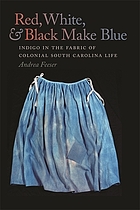
Red, white, et black make blue : indigo in the fabric of colonial South Carolina life
Feeser, Andrea. Red, White, Et Black Make Blue: Indigo in the Fabric of Colonial South Carolina Life. Athens, Ga: Univ. of Georgia Press, 2013. Print.

Front Cover
Tapestry in the Baroque: Threads of Splendor by Thomas P. Campbell, Pascal-François Bertrand, Jeri Bapasola, Palacio Real (Madryt)., Metropolitan Museum of Art (New York, N.Y.)

The secret lives of colour
St, Clair K. The Secret Lives of Colour. , 2016. Print.

Pantone:   https://www.beeghlyandcompany.com/blogs/blog/reveling-in-pure-joy-viva-magenta-is-pantones-2023-color-of-the-year

Pinterest:  https://pin.it/5KwP75Z


Textiles and Dyes

On-line Resources:
https://www.neh.gov/humanities/2015/julyaugust/feature/red-all-over-how-tiny-bug-changed-the-way-we-see-the-world

Red All Over: How a Tiny Bug Changed the Way We See the World

What makes the best red? The Spanish found out in sixteenth-century Mexico.

HUMANITIES, July/August 2015, Volume 36, Number 4


Florentine Codex, a twelve-volume encyclopedia of the New World
 Huejotzingo codex

Padilla, Carmella, and Barbara Anderson. A Red Like No Other: How Cochineal Colored the World : an Epic Story of Art, Culture, Science and Trade. New York: Skira Rizzoli, 2015. Print.
Three reds : cochineal, hematite, and cinnabar in the pre-Hispanic Mesoamerican world / Claudia Brittenham --
Red at court : did the Maya at Bonampak know cochineal? / Mary Miller --
The politics of Nocheztli : the Florentine codex and the Nahua world of New Spain / Diana Magaloni Kerpel --
Tradition and innovation : cochineal and Andean keros / Ellen Pearlstein [and four others] --
The cochineal commodity chain : Mexican cochineal and the rise of global trade / Carlos Marichal --
To dye for : the many reds of Asia / Cristin McKnight Sethi --
Five barrels of cochineal : a gift from King Philip III of Spain to Shah ʻAbbas I of Iran / Marianna Shreve Simpson --
Reds in the land of the rising sun : cochineal and traditional red dyes in Japan / Monica Bethe, Yoshiko Sasaki --
Red echoes of enslavement : cochineal red, West Africa, and the slave trade / Emily Lynn Osborn --
Point of origin : genetic diversity and the biogeography of the cochineal insect / Alex van Dam [and three others] --
Crimson to scarlet : from American tradition to European experimentation / Ana Roquero --
Finer than the cochineal of New Spain : painting of the natural, civil, and geographic history of the kingdom of Peru / Rocío Bruquetas --
Proof positive : the science of finding cochineal / Estrella Sanz Rodríguez --
Shades of red : color and culture in Andean textiles / Elena Phipps --
Bleeding threads : cochineal in Mexican textiles / Alejandro de Ávila B. --
Not only red : cochineal in the eighteenth-century European woolen cloth industry / Dominique Cardon --
Dressing red : cochineal red in eighteenth-century garments from the Museo del Traje / Elena Vázquez García, Irene Seco Serra --
Recycled reds : raveled insect-dyed yarns in blankets of the American Southwest / Ann Lane Hedlund --
Wrapped in strouding : trade cloth and the American Indians of the Plains / Marsha C. Bol --
The color of power : red in the portraiture of the Spanish and British Empires / Michael A. Brown --
"One of the most beautiful reds" : cochineal in European painting / Jo Kirby --
Carmine of the Indies : cochineal in Spanish painting and sculpture (1550-1670) / Rocío Bruquetas, Marisa Gómez --
Interweaving Europe and Central Asia : connections in ethnobotany, folklore, and Polish cochineal / Anna Naruta-Moya --
"More reddish than grain" : cochineal in colonial Andean painting / Gabriela Siracusano, Marta Maier --
Painting in New Spain : conveying meaning through cochineal / Barbara Anderson --
Nocheztli --
blood of the prickly pear : cochineal in domestic furnishings in New Spain and Mexico / Gustavo Curiel --
Looking for red in all the wrong places : cochineal in Spanish colonial New Mexico / Robin Farwell Gavin, Josie Caruso --
Reconsidering cochineal in Spanish colonial New Mexico : questions for the future / Cordelia Thomas Snow --
New colors, old tints : uncovering fortuny and cochineal / Elvira González Asenjo, Lucina Llorente Llorente --
Carmine and earthly delights : cochineal in cosmetics, contemporary craft, fashion, and the strawberry frappuccino / Nicolasa Chávez --
Romantic revival : cochineal in contemporary New Mexican Hispano art / Nicolasa Chávez --
Red collection : Orlando Dugi's cochineal-inspired fashion design / Carmella Padilla

edited by Carmella Padilla & Barbara Anderson ; principal photography by Blair Clark.


  • The Woolery.com, Frankfort, Kentucky
  • Catherine Ellis, Ellis Textiles, https://www.ellistextiles.com/
  • Sarah Bellos of Stony Creek Colors https://stonycreekcolors.com/ 
  • Blog: http://riihivilla.blogspot.com/
  • Blog:  https://botanicalcolors.com/ Jubilee Farm, Carnation, Washington
  • Blog Article:  https://thelaurelofasheville.com/arts/visual-arts/penland-gallery-presents-further-evidence-the-art-of-natural-dyes/

Synthetic Dyes

  • Rit Guide to Color Mixtures https://www.ritdye.com/color-formulas/2006-2016
  • 1437 w. Morris Indianapolis, Indiana (Best Foods, CPC, Phoenix Brands)*
  • Tintex https://www.tintex.ca/ https://www.tintex.ca/pages/fabric-dye-colour-guide
  • Old Companies 

Image result for dyola dye

Image result for dyola dye
Dy-Ol-A Antique Dy-o-la Dye Cabinet Johnson - Richardson Company Burlington, Vermont 


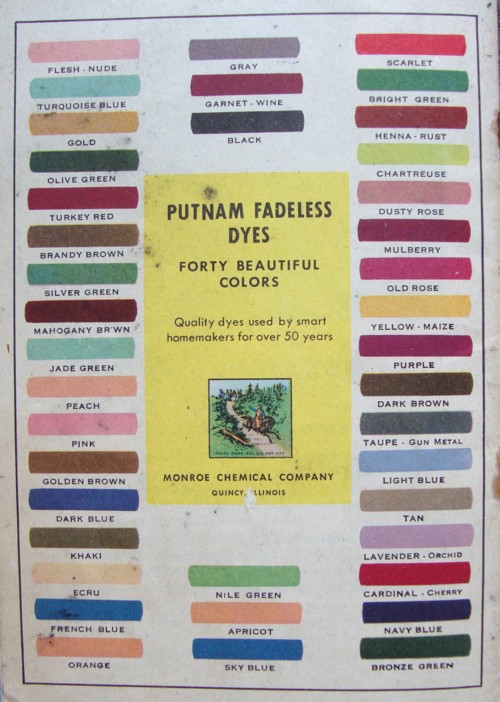
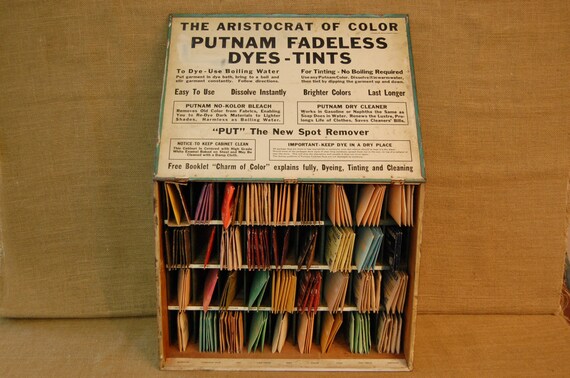
Image result for putnam dye

Image result for putnam dye
Putnam, Monroe Chemical Company, Quincey, Illinois


Image result for diamond dyes Image result for diamond dyes
Diamond Dye and Tint Wells, Richardson, and Co.,  Burlington, Vermont  


 *"By 1925, metropolitan Chicago was well on its way to become one of the largest industrial cities in the world with the following major industries (listed and ranked according to their economic importance): “slaughtering/meat packing, printing/publishing, foundry/ metal working, electrical, clothing, iron/ steel making/milling, pipe fittings, food and personal care industries”(2). Many of these Chicago industries employed chemists, generally in support of their operations. Examples included Best Foods Laboratories, Swift and Co. in the stockyards, Armour’s nearby laboratories and Universal Oil Products suburban Riverside facilities providing petroleum refining process research support for the oil industry. This is a historical documentary about a number of individual chemists in Chicago who successfully established new specialty chemical(3) businesses during the 1920’s, ‘30’s and ‘40’s, many during the “Great Depression”, when synthetic organic chemistry was in its infancy. These remarkable, well-educated entrepreneurial chemical pioneers had several characteristics in common. They were courageous, determined risktakers who identified what the market needed, and worked to fulfill those needs. Most were good salesmen, or out of necessity, soon became one. Their professional careers in chemistry will be examined through the specialty chemical companies involved, including Best Foods Company, Emulsol, Witco, Ninol and Stepan. Some of these individuals were European immigrants who came to the U.S. looking for freedom and opportunity. They all labored and succeeded in America’s free market economy, and truly lived the “American Dream,” and it all started in Chicago. This historical documentary begins with the Best Foods Company. Best Foods Company (1898-2000) In 1922, giant conglomerate Corn Products Corporation’s Gold Dust subsidiary had its Best Foods consumer products division consolidate its various food and related consumer products operations, and established a relatively large laboratory in Chicago. Their product lines were gradually increased to include Kayro Corn Syrup, other syrups, jams, Mazola Corn Oil, Hellmann’s Mayonnaise, dressings, margarine, Shinola Polish, Gold Dust soap products, laundry starches and others. Because of its size, Best Foods was able to attract a number of well-educated chemists. Some were graduates of the University of Chicago, while others were European immigrants seeking better opportunities in the “New World.” By 1933, in the midst of the “Great Depression” President-elect Franklin D. Roosevelt proposed a job saving program, asking employers to retain their employees, putting them on a half time basis with reduced pay. For necessary cost and job saving measures, Best Foods’ management decided to follow the President’s recommendation. Thus, their employee’s work was reduced to halftime with drastically reduced wages. As an incentive to keep its chemists, Best Foods allowed their lab personnel to utilize their lab facilities pursuing projects of their own choosing, working on their own free time. Some used this opportunity to develop new and patentable products and processes for themselves (4). Over the years, it would turn out that Best Foods Laboratories proved to be a training ground for many of their chemists, especially during and right after the “Great Depression.” Some left the company and established their own specialty chemical companies, while others would leave to join those who already started new businesses. This group of former Best Foods chemists, included Russian immigrant Dr. Wolf Kritchevsky, a well-educated dye expert, who left Best Foods in about 1934 to start Rit Products Company in Chicago, and whose patents on alkylolaminefatty acid condensation products (later to be named Ninols) would contribute to his sons starting Ninol Laboratories in Chicago in 1940 (4). Morris B. Katzman and Albert K. Epstein also working on their own free time secured a patent on certain fatty amide emulsifying agents. Immigrant chemist, Albert K. Epstein left Best Foods in 1935 to become president of his new chemical company called Emulsol Corporation. Other chemists of Best Foods left and joined Emulsol including Benjamin R. Harris, Morris B. Katzman, Frank J. Cahn, and John J. Morrisroe (4). Katzman and Cahn later, in 1952, would leave Emulsol to start Process Chemicals Company in Los Angeles (4,5). John Morrisroe left Emulsol in 1951, invented his SO2 solvent SO3 sulfonation process (6), and started Pilot Chemical Company in Santa Fe Springs, California in 1952 (7). Best Foods continued to grow globally as the largest international food giant, constantly undergoing acquisitions, mergers, an occasional unit spin off, and frequent name changes. Corn Products Refining Company and Best Foods Inc. merged in 1959, and later in 1969 changed its name to C.P.C. International. In 1996 C.P.C. International had sales of $9.8 billion and they again split off Best Foods during 1997. Unilever acquired Best Foods in 2000 (8). (1) The author of this historical documentary was employed by Ninol Laboratories from 1945-1957, and by Stepan Co. from 1957 to 1987. (2) Cunningham, J. D. Chicago-The World’s Youngest Great City; American Publishers: Chicago, 1929; p 99. (3) Specialty chemicals are generally defined as chemical products or intermediates that contribute or impart special physical or chemical features and/or improved product performance properties or attributes to a formulation or consumer product. Generally the somewhat lower volume specialty chemicals’ unique features may warrant or com -mand a premium or price advantage which helps to differentiate them from the larger volume, chemically well defined, lower margin priced commodity chemicals. (4) Private communication on November 15, 1992 between Mr. Jerome Kritchevsky and the author discussing his father’s life history. (5) News, JAOCS, September 1952, p. 18. (6) Morrisroe, J. J., U.S. Patent 2,703,788, March 8, 1956. (7) History and timeline of Pilot Chemical Co." http://www.pilotchemicalco.com (accessed Feb. 2012). (8) CPC International Company history. http://www.cpcinter national.com https://chicagoacs.starchapter.com/images/downloads/Chemical_Bulletin/12sep_high.pdf

https://www.facebook.com/115024653479383/posts/157650745883440/?mibextid=rS40aB7S9Ucbxw6v


https://material-matters.cityandguildsartschool.ac.uk/pigment/in-conversation-pigment/


Grassroots Horticulture

__________________________________________________________________________
__________________________________________________________________________