__________________________________________________________________________
Textiles
Tapestry, yarns, and dye theory for color
Traditional natural dyes include indigo and woad for blue; a warm red came from madder and red also came from dried insects known as Kermes, and from cochineal and Brazilwood. Purples were made from the orchilis lichen, and the various mordants available together with blending, gave a wide range of colours. Dyers preferred resources that proved resistant to light so they were always on the watch for botanical discoveries.
 |
|
Newberry Library
"Indian Collecting Cochineal with a Deer Tail" from Memoria sobre la naturaleza, cultivo, y beneficio de la grana
|
 |
| Scale insects on leaves, or paddles, of cactus produce a red acidic substance |
The cochineal is a scale insect, from which the natural dye carmine is derived. This insect lives on cacti in the genus Opuntia, feeding on plant moisture and nutrients. These insects are found on the pads of prickly pear cacti, then are brushed off and dried. The insect produces carminic acid that deters predation by other insects. Carminic acid, typically 17-24% of dried insects' weight, can be extracted from the body and eggs, then mixed with aluminium or calcium salts to make carmine dye, also known as cochineal. The carmine dye was used in Central America in the 15th century for coloring fabrics and became an important export good. This dye has been an important economic commodity and has created fascinating mysteries and intrigues.
Table I: Natural Sources of Plant Dyes and Ink
| Plant Name | Common Name | Part(s) Used | Color | Textile Examples |
| | | | |
| Acacia catechu see Senegalia catechu | cutch | Heartwood | brown khaki, red (food) | |
| Alkanna tinctoria | dyer's bugloss, dyer's alkanet | | red | |
| Annatto | lipstick tree, Annatto, Achiote (Bixa orellana) | seeds | red, yellow, orange | |
| Bixa orellana | lipstick tree, Annatto | seeds | red, yellow, orange | |
| Bixa Orellana Linn | lipstick tree, Annatto/Ornato | seeds | red, yellow, orange | |
| Caesalpinia spp. | Brazilwood sappenwood | heartwood | red (brazilin) | |
| Dactylopius coccus (scale insect) | Cochineal | | red (carmine) | |
| Frangula alnus or Rhamnus frangula | alder buckthorn | bark | red with fermentation, yellow | |
| Frangula alnus or Rhamnus frangula | alder buckthorn | berries | green | |
| Indigo dye (Greek indicon, "from India") | indigo | Leaves | Indigo Blue | |
| Indigofera suffruticosa | Añil | Leaves | Indigo Blue | |
| Indigofera tinctoria | true indigo | Leaves | Indigo Blue | |
| Isatis tinctoria | woad, dyer's woad | Leaves | Indigo Blue | The Hunt of the Unicorn Tapestry |
| Juglans nigra | Eastern black walnut | Drupes (fruit) | brownish-black | |
| Morinda tinctoria | Indian mulberry | root bark | red, chocolate or purple | |
| Reseda lutea | ladyer's rocket, dyer's weed, weld, woold, and yellow weed | leaves, flowers | Yellow | The Hunt of the Unicorn Tapestry |
| Roccella tinctoria | archil lichen (fungus) | | purple | Tapestries from Grainville-la-Teinturière, Normandy |
| Rubia tinctoria | madder, dyer's madder | roots | Red (Alizarin) | The Hunt of the Unicorn Tapestry, linen in Tutankhamen’s tomb (1350 BC), wool, leather, cotton, silk |
References______________________________________


Botanical Inks : Plant-to-Print Dyes, Techniques and Projects Behan
Feeser, Andrea. Red, White, Et Black Make Blue: Indigo in the Fabric of Colonial South Carolina Life. Athens, Ga: Univ. of Georgia Press, 2013. Print.

Tapestry in the Baroque: Threads of Splendor by Thomas P. Campbell, Pascal-François Bertrand, Jeri Bapasola, Palacio Real (Madryt)., Metropolitan Museum of Art (New York, N.Y.)
St, Clair K. The Secret Lives of Colour. , 2016. Print.
Pantone: https://www.beeghlyandcompany.com/blogs/blog/reveling-in-pure-joy-viva-magenta-is-pantones-2023-color-of-the-year
Pinterest: https://pin.it/5KwP75Z
Textiles and Dyes
On-line Resources:
https://www.neh.gov/humanities/2015/julyaugust/feature/red-all-over-how-tiny-bug-changed-the-way-we-see-the-world
Red All Over: How a Tiny Bug Changed the Way We See the WorldWhat makes the best red? The Spanish found out in sixteenth-century Mexico. HUMANITIES, July/August 2015, Volume 36, Number 4
Florentine Codex, a twelve-volume encyclopedia of the New World
Huejotzingo codex
Padilla, Carmella, and Barbara Anderson. A Red Like No Other: How Cochineal Colored the World : an Epic Story of Art, Culture, Science and Trade. New York: Skira Rizzoli, 2015. Print.
Three reds : cochineal, hematite, and cinnabar in the pre-Hispanic Mesoamerican world / Claudia Brittenham --
Red at court : did the Maya at Bonampak know cochineal? / Mary Miller --
The politics of Nocheztli : the Florentine codex and the Nahua world of New Spain / Diana Magaloni Kerpel --
Tradition and innovation : cochineal and Andean keros / Ellen Pearlstein [and four others] --
The cochineal commodity chain : Mexican cochineal and the rise of global trade / Carlos Marichal --
To dye for : the many reds of Asia / Cristin McKnight Sethi --
Five barrels of cochineal : a gift from King Philip III of Spain to Shah ʻAbbas I of Iran / Marianna Shreve Simpson --
Reds in the land of the rising sun : cochineal and traditional red dyes in Japan / Monica Bethe, Yoshiko Sasaki --
Red echoes of enslavement : cochineal red, West Africa, and the slave trade / Emily Lynn Osborn --
Point of origin : genetic diversity and the biogeography of the cochineal insect / Alex van Dam [and three others] --
Crimson to scarlet : from American tradition to European experimentation / Ana Roquero --
Finer than the cochineal of New Spain : painting of the natural, civil, and geographic history of the kingdom of Peru / Rocío Bruquetas --
Proof positive : the science of finding cochineal / Estrella Sanz Rodríguez --
Shades of red : color and culture in Andean textiles / Elena Phipps --
Bleeding threads : cochineal in Mexican textiles / Alejandro de Ávila B. --
Not only red : cochineal in the eighteenth-century European woolen cloth industry / Dominique Cardon --
Dressing red : cochineal red in eighteenth-century garments from the Museo del Traje / Elena Vázquez García, Irene Seco Serra --
Recycled reds : raveled insect-dyed yarns in blankets of the American Southwest / Ann Lane Hedlund --
Wrapped in strouding : trade cloth and the American Indians of the Plains / Marsha C. Bol --
The color of power : red in the portraiture of the Spanish and British Empires / Michael A. Brown --
"One of the most beautiful reds" : cochineal in European painting / Jo Kirby --
Carmine of the Indies : cochineal in Spanish painting and sculpture (1550-1670) / Rocío Bruquetas, Marisa Gómez --
Interweaving Europe and Central Asia : connections in ethnobotany, folklore, and Polish cochineal / Anna Naruta-Moya --
"More reddish than grain" : cochineal in colonial Andean painting / Gabriela Siracusano, Marta Maier --
Painting in New Spain : conveying meaning through cochineal / Barbara Anderson --
Nocheztli --
blood of the prickly pear : cochineal in domestic furnishings in New Spain and Mexico / Gustavo Curiel --
Looking for red in all the wrong places : cochineal in Spanish colonial New Mexico / Robin Farwell Gavin, Josie Caruso --
Reconsidering cochineal in Spanish colonial New Mexico : questions for the future / Cordelia Thomas Snow --
New colors, old tints : uncovering fortuny and cochineal / Elvira González Asenjo, Lucina Llorente Llorente --
Carmine and earthly delights : cochineal in cosmetics, contemporary craft, fashion, and the strawberry frappuccino / Nicolasa Chávez --
Romantic revival : cochineal in contemporary New Mexican Hispano art / Nicolasa Chávez --
Red collection : Orlando Dugi's cochineal-inspired fashion design / Carmella Padilla |
| edited by Carmella Padilla & Barbara Anderson ; principal photography by Blair Clark. |
|---|
|
| | |
|
- The Woolery.com, Frankfort, Kentucky
- Catherine Ellis, Ellis Textiles, https://www.ellistextiles.com/
- Sarah Bellos of Stony Creek Colors, https://stonycreekcolors.com/
- Blog: http://riihivilla.blogspot.com/
- Blog: https://botanicalcolors.com/ Jubilee Farm, Carnation, Washington
- Blog Article: https://thelaurelofasheville.com/arts/visual-arts/penland-gallery-presents-further-evidence-the-art-of-natural-dyes/
Synthetic Dyes
- Rit Guide to Color Mixtures https://www.ritdye.com/color-formulas/2006-2016
- 1437 w. Morris Indianapolis, Indiana (Best Foods, CPC, Phoenix Brands)*
- Tintex https://www.tintex.ca/ https://www.tintex.ca/pages/fabric-dye-colour-guide
- Old Companies
 |
| Dy-Ol-A Antique Dy-o-la Dye Cabinet Johnson - Richardson Company Burlington, Vermont |
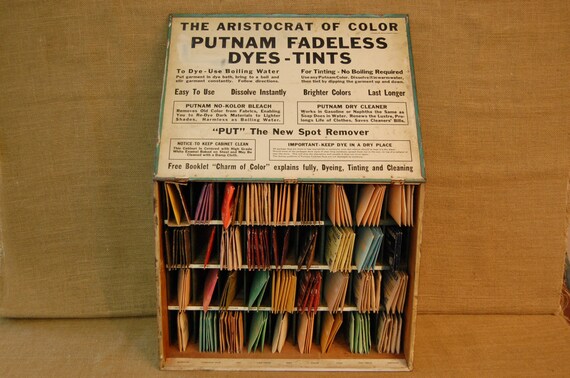 |
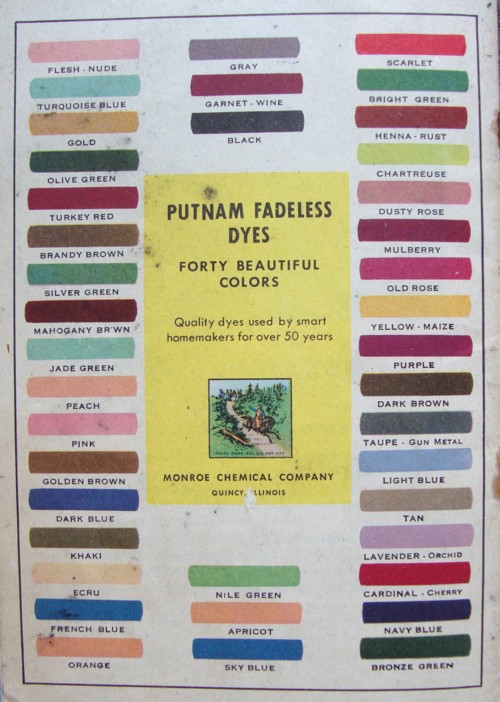
| Putnam, Monroe Chemical Company, Quincey, Illinois |


Diamond Dye and Tint Wells, Richardson, and Co., Burlington, Vermont
*"By 1925, metropolitan Chicago was
well on its way to become one of the
largest industrial cities in the world with
the following major industries (listed
and ranked according to their economic
importance): “slaughtering/meat
packing, printing/publishing, foundry/
metal working, electrical, clothing, iron/
steel making/milling, pipe fittings, food
and personal care industries”(2). Many
of these Chicago industries employed
chemists, generally in support of their
operations. Examples included Best
Foods Laboratories, Swift and Co. in the
stockyards, Armour’s nearby laboratories
and Universal Oil Products suburban
Riverside facilities providing petroleum
refining process research support for the
oil industry.
This is a historical documentary about
a number of individual chemists in
Chicago who successfully established
new specialty chemical(3) businesses
during the 1920’s, ‘30’s and ‘40’s, many
during the “Great Depression”, when
synthetic organic chemistry was in its
infancy.
These remarkable, well-educated
entrepreneurial chemical pioneers had
several characteristics in common. They
were courageous, determined risktakers
who identified what the market
needed, and worked to fulfill those
needs. Most were good salesmen, or
out of necessity, soon became one.
Their professional careers in chemistry
will be examined through the specialty
chemical companies involved, including
Best Foods Company, Emulsol, Witco,
Ninol and Stepan.
Some of these individuals were
European immigrants who came to the
U.S. looking for freedom and opportunity.
They all labored and succeeded in
America’s free market economy, and
truly lived the “American Dream,” and it
all started in Chicago.
This historical documentary begins with
the Best Foods Company.
Best Foods Company
(1898-2000)
In 1922, giant conglomerate Corn
Products Corporation’s Gold Dust
subsidiary had its Best Foods consumer
products division consolidate its various
food and related consumer products
operations, and established a relatively
large laboratory in Chicago. Their
product lines were gradually increased to
include Kayro Corn Syrup, other syrups,
jams, Mazola Corn Oil, Hellmann’s
Mayonnaise, dressings, margarine,
Shinola Polish, Gold Dust soap products,
laundry starches and others. Because of
its size, Best Foods was able to attract
a number of well-educated chemists.
Some were graduates of the University
of Chicago, while others were European
immigrants seeking better opportunities
in the “New World.”
By 1933, in the midst of the “Great
Depression” President-elect Franklin
D. Roosevelt proposed a job saving
program, asking employers to retain their
employees, putting them on a half time
basis with reduced pay. For necessary
cost and job saving measures, Best
Foods’ management decided to follow
the President’s recommendation. Thus,
their employee’s work was reduced to
halftime with drastically reduced wages.
As an incentive to keep its chemists,
Best Foods allowed their lab personnel
to utilize their lab facilities pursuing
projects of their own choosing, working
on their own free time. Some used
this opportunity to develop new and
patentable products and processes for
themselves (4).
Over the years, it would turn out that
Best Foods Laboratories proved to
be a training ground for many of their
chemists, especially during and right
after the “Great Depression.” Some left
the company and established their own
specialty chemical companies, while
others would leave to join those who
already started new businesses. This
group of former Best Foods chemists,
included Russian immigrant Dr. Wolf
Kritchevsky, a well-educated dye expert,
who left Best Foods in about 1934 to
start Rit Products Company in Chicago,
and whose patents on alkylolaminefatty
acid condensation products (later
to be named Ninols) would contribute to
his sons starting Ninol Laboratories in
Chicago in 1940 (4). Morris B. Katzman
and Albert K. Epstein also working on
their own free time secured a patent on
certain fatty amide emulsifying agents.
Immigrant chemist, Albert K. Epstein left
Best Foods in 1935 to become president
of his new chemical company called
Emulsol Corporation. Other chemists
of Best Foods left and joined Emulsol
including Benjamin R. Harris, Morris B.
Katzman, Frank J. Cahn, and John J.
Morrisroe (4).
Katzman and Cahn later, in 1952,
would leave Emulsol to start Process
Chemicals Company in Los Angeles
(4,5). John Morrisroe left Emulsol in
1951, invented his SO2 solvent SO3
sulfonation process (6), and started Pilot
Chemical Company in Santa Fe Springs,
California in 1952 (7).
Best Foods continued to grow globally
as the largest international food giant,
constantly undergoing acquisitions,
mergers, an occasional unit spin off, and
frequent name changes. Corn Products
Refining Company and Best Foods
Inc. merged in 1959, and later in 1969
changed its name to C.P.C. International.
In 1996 C.P.C. International had sales of
$9.8 billion and they again split off Best
Foods during 1997. Unilever acquired
Best Foods in 2000 (8).
(1) The author of this historical
documentary was employed by Ninol
Laboratories from 1945-1957, and by
Stepan Co. from 1957 to 1987.
(2) Cunningham, J. D. Chicago-The
World’s Youngest Great City; American
Publishers: Chicago, 1929; p 99.
(3) Specialty chemicals are generally
defined as chemical products or
intermediates that contribute or impart
special physical or chemical features
and/or improved product performance
properties or attributes to a formulation
or consumer product. Generally the
somewhat lower volume specialty
chemicals’ unique features may warrant
or com -mand a premium or price
advantage which helps to differentiate
them from the larger volume, chemically
well defined, lower margin priced
commodity chemicals.
(4) Private communication on November
15, 1992 between Mr. Jerome
Kritchevsky and the author discussing
his father’s life history.
(5) News, JAOCS, September 1952, p. 18.
(6) Morrisroe, J. J., U.S. Patent
2,703,788, March 8, 1956.
(7) History and timeline of Pilot Chemical
Co." http://www.pilotchemicalco.com
(accessed Feb. 2012).
(8) CPC International Company history.
http://www.cpcinter national.com https://chicagoacs.starchapter.com/images/downloads/Chemical_Bulletin/12sep_high.pdf
https://www.facebook.com/115024653479383/posts/157650745883440/?mibextid=rS40aB7S9Ucbxw6v
https://material-matters.cityandguildsartschool.ac.uk/pigment/in-conversation-pigment/
Grassroots Horticulture
__________________________________________________________________________
__________________________________________________________________________




.jpg)


.jpg)


