Showing posts with label Chicago. Show all posts

Monday, June 1, 2020

Garden Style | Urban Row House

__________________________________________________________
__________________________________________________________

Seasonal Design Idea Boards

CREATING a small welcoming organic space

Tasteful Entrances 


A hardscape of flagstone, decorative fence, and a strategically placed chair or bench. Groundcover choices galore would include steppable plants (sedum), short grasses (monkey grass), and vines (creeping jenny). Dwarf  evergreens could include boxwood, dwarf Mugo pine, or birds nest spruce. 


Pull the eye toward the door by placing the closest planter low and the planter nearest the door high. By avoiding the use of two planters at the approach to the door, the effect is a wider walkway and continuation.

These two entrances appealed to my sense of good design while on a short trip to Chicago. I was glad to find a bed and breakfast so I could enjoy a brief morning walk.  A benefit of staying at a bed and breakfast is the allure of being immersed in the common day-to-day culture and neighborhood feel of a particular place. A morning coffee shared with others and shared information on favorite and worthwhile restaurants, gardens, and historical sites is another joy. In Chicago, you might learn the best pizza place and also and more importantly, a rule for successful ordering. Because the restaurant makes a limited number of deep dish each day, you must order your pizza early.  

Millennium Park was in full spring bloom and Lurie Park was awakening from a deep winter's sleep. 

I hope this garden "recipe board", (aka a horticulturist's 3 x 5 or 4 x 6), will inspire others to experiment with new ingredients for your particular taste. 


If you liked this post you might also like:

All material © 2007-2017 by Jeanette Hyden for Grassroots Horticulture

Garden Style | Arts & Crafts and Prairie Style (1900-1930)

________________________________________________
________________________________________________

"Using Nature as our basis for design, a building or design must grow, as Nature grows, from the inside out. Most architects design their buildings as a shell and force their way inside. Nature grows from the idea, a seed, and reaches out to its surroundings. A building thus, is akin to an organism and mirrors the beauty and complexity of Nature.” 
                                                                                                                                           Eric Corey Freed


Frank Lloyd Wright (1867-1959), architect
Prairie Style, Arts and Crafts Movement
The Frank Lloyd Wright Home, Studio and Garden served as Wright's primary residence and studio from 1889 to 1909. Wright used his home as an architectural laboratory, experimenting with space, form, light, materials, furnishings and decorative arts. Frank Lloyd Wright referring to the lot purchased from John Blair (1820-1906), nursery man and landscape designer, said,
                      
"I remember well the remarkable character of the foliage on the old Blair lot."


prairie style, 1889
landscape integration with the home
forest avenue entrance, west facing
frank lloyd wright studio and home
oak park, illinois
HORIZONT


Prairie Style Features


Strong horizontal lines 


reflecting the arts and craft movement 
horizontal lines and horizontal bands of windows


951 Chicago Avenue
Exterior fence encloses the yard 
replicating the horizontal lines of the studio
Kentucky Coffeetrees grace the boulevard


Prairie Style Features

Image result for frank lloyd wright furniture

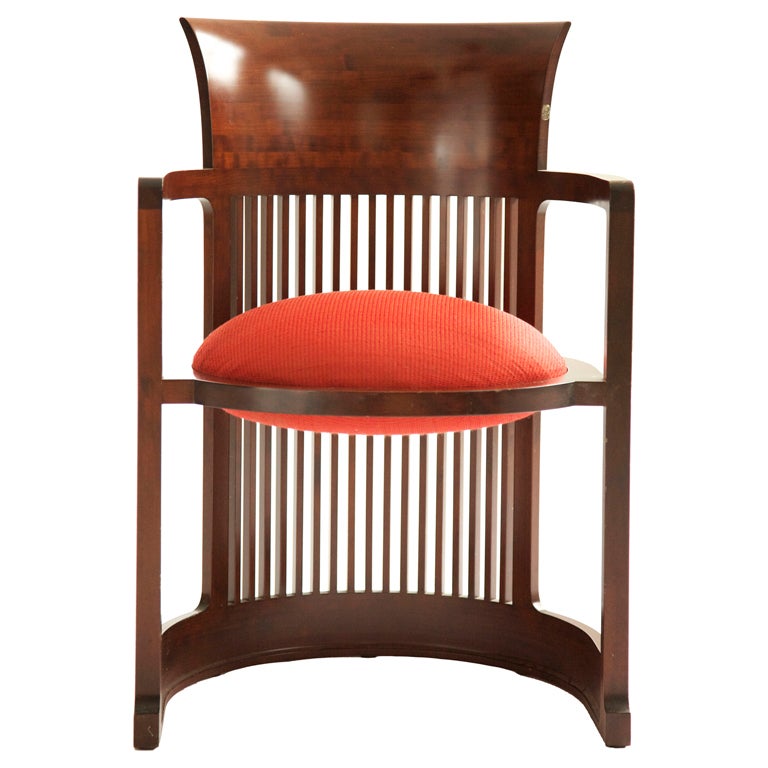
wooden cabinets and furniture artistry

Kentucky Coffeetree 
(Gymnocladus dioica)  
Seed Pod
In the land of Lincoln, the Kentucky coffeetree graces the boulevard outside the Frank Lloyd Wright Studio in Oak Park. The lumber from the coffeetree is cherished by cabinetmakers and might explain the choice of this rare tree. From what I have read, Wright's favorite tree was the ginkgo.


                                                                                                                                  Layers of horizontal lines                                            

Two sculptures, referred to as "Boulders" bookend the entryway. Nichols Bros. Stoneworks Dry Cast Sandstone is designed to replicate that of old world carved stone.
Nichol Brothers Stoneworks


Mondrian-esque art deco stained glass
Wright, as a child was influenced by


Geometric architectural sprite sculpture
Frank Lloyd, Architect and Alfonso Inanelli,sculpture 
originally designed for hyde park's midway gardens wall (1913-1929)
located at 60th and cottage grove, chicago, Illinois
REMOVED TO BILTMORE resort, Arizona.
. 


Prominent Landscape designers of the "Prairie Style" era are Jens Jensen, O. C. Simonds, Walter Burley Griffin, and Warren H. Manning.


Chicago

Osaka Garden
Landscape Architecture |Frank Lloyd Wright Studio
Landscape Architecture | Urban Row

Tuesday, January 1, 2013

Osaka Garden | Chicago

All through the long winter, I dream of my garden. On the first day of spring, I dig my fingers deep into the soft earth. I can feel its energy, and my spirits soar. --Helen Hayes


Osaka Garden is a Japanese stroll garden nestled on the north end of the Wooded Island in historic Jackson Park, located in Chicago. The origins of Osaka Garden date back more than 100 years, when the Japanese government gave a beautiful building to Chicago for the 1893 World's Columbian Exposition. This gift planted the seeds of a lasting relationship between Chicago and Japan. The Osaka Gardens Chicago still has many buildings and artifacts from that time period, including an ornate stone Japanese lantern.

A Robin in a Field of White Clover


Lilies

Late spring and early summer is the best time to admire the flowers and the plants at their peak.
The Osaka Garden is symbolic of a mini landscape with rocks, bushes, and ponds representing mountains, trees and lakes. This style of garden was popular with 17th century Japanese noblemen who used to carefully tend their gardens, ensuring that all plants and trees were kept to proper, human-sized scale.  From the pebbles in the Turtle Pond, to the stone Japanese lanterns, the rocks of the garden represent the principles of a Japanese garden, as well as the geologic ages. The placement of each rock in the garden is also carefully considered.


Located on Wooded Island in the heart of Chicago's Jackson Park, the peaceful ambiance of the Osaka Gardens is a great way to soothe the mind and calm the soul. The grounds feature a series of water features and bridges.

The Osaka Garden is considered to be a classic example of a Japanese Stroll garden. This type of garden dates back to the 17th century, and is designed to both reveal and hide features of the garden as one walks through it, with each piece of the garden offering a new view.


Meandering paths lead to the Arching Moon Bridge.

Water rapids
 Japanese Bridge


Osaka Gardens is located  just south of the Museum of Science and industry.


Shade loving hostas dot each step. 


Japanese Lantern


Shoreline and young aquatic plantings in the lagoon and viewing the shallow south end of the lower pool.


Calm and cool


Relax, reflect and meditate.
Peaceful and Tranquil.


Robin Redbreast 
said to be the first sign of spring


Chicago

Osaka Garden
Landscape Architecture |Frank Lloyd Wright Studio
Landscape Architecture | Urban Row