

 |
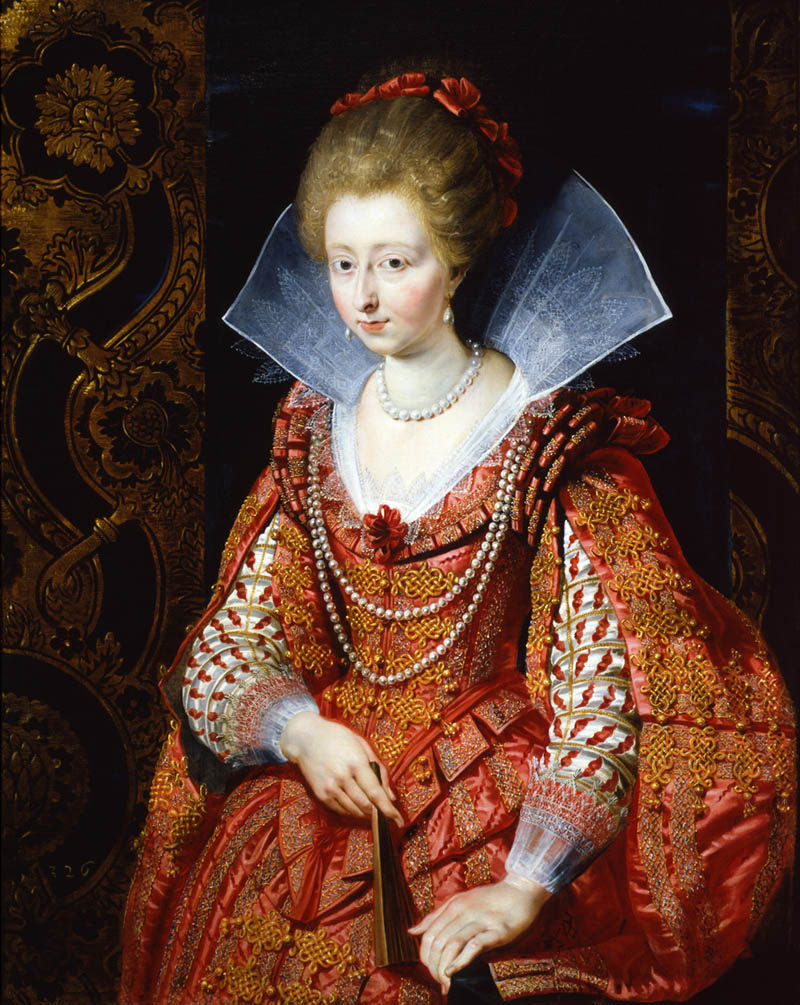
| Peter Paul Rubens (Flemish, 1577–1640), Portrait of Charlotte-Marguerite de Montmorency, Princess of Condé, c. 1609. Oil on canvas. Frick Art & Historical Center 1970.49. |


Elizabeth Stuart to Frederick V.



Portrait of Frederick believed to have been painted in 1613 the year of his marriage to Elizabeth
by Michiel Jansz. van Mierevelt

Elizabeth Stuart (1596 – 1662), the only surviving daughter of James I and VI and his wife Anne of Demark at Dunfermline Palace in Fife.

Elizabeth Stuart (1596 – 1662), age 9

Elizabeth Stuart (1596 – 1662)
Queen of Bohemia

The Winter Queen
Elizabeth Stuart (1596 – 1662)

Frederick V, Count Palatine of the Rhine

George Villiers, Duke of Buckingham
(1592 – )

France


 Michiel Jansz van - Mierevelt Portrait of a young aristocratic Dame (Orange bows, brooch)
Paulus Moreelse Dutch, 1571-1638. Portrait of a Young Lady, c. 1620 |


| Needlework patterns, Les Singuliers et Nouveaux Pourtaicts, was published in many editions between 1587 and 1623. An unabridged reprint of a 1909 facsimile of this book was issued by Dover Books as Renaissance Patterns for Lace, Embroidery and Needlepoint in 1971. |
Fibers | Silk_____________________________
Griffin, https://www.griffin.de/en/
Fibers | Linen____________________________

 HISTORY OF THE BARBOUR FLAX SPINNING COMPANY, PATERSON, NEW JERSEY Taken from “The Co-Operator,” newspaper of the Barbour Mills V1 N3 June 22, 1918 The parent establishment of this Company, that of William BARBOUR & Sons, is in Lisburn, Ireland, where their mills have been running since 1785. In 1864, when the duty was taken from Flax Machinery, the house of William Barbour & Sons determined to establish branch works in Paterson. The manufacture of Shoe Threads and Linen Thread, where are largely used in various leather manufactures, was begun on a liberal scale in mills called “Passaic Flax Thread Works,” driven by water power and employing 450 hands. This mill was also known as “Passaic Mill No. 2” and was formerly run by John COLT, for the weaving of fine sheetings and cotton duck. The mill is known at present as “Barbour Flax Spinning Co., Spruce Street Mill.” An extensive department was established for the spooling of Linen Threads, imported in a bundle. A manufactory known as “Arkwright Mills” was also started for the manufacture of Flax Twines and the coarser grades of goods. The business steadily increased from 1864 to 1872 when the foundations of the Grand Street Mill were laid and additional machinery was ordered from Ireland, but the revenue oppression of 1872 checked the enterprise. In 1877, the erection of this mill proceeded. It was originally 50 feet front on Grand Street by 250 feet deep, and four stories high. It was one of the finest mills in this section of the country at that time and it had scarcely been stocked with machinery and occupied before plans were laid to increase the floor space and, in 1878 the building was enlarged to 50 by 400 feet. In February 1879, the Spruce Street Mill was destroyed by fire. It was at once rebuilt, an imitation in all respects of the Grand Street Mill. In the year 1881, the present Barbour Flax Spinning Co., A.H. Hart Mill, was constructed and was then known as the Granite Mill, from the stone used in its construction. In 1889, a third addition to the Grand Street Mill was made, making its present size 500 feet, and since this time, numerous buildings have been added, the principal ones being the 1903 building, facing on Grand Street, and the new storehouse, on the corner of Dale Avenue and Grand Street, which was built one year later. The Grand Street Mill still has on its staff several actively engaged employees whose term of service dates back to the early constructive period.
 by The Passaic County Historical Society

Fibers | Cotton____________________________
Cotton is a soft, fluffy staple fiber that grows in a boll, or protective case, around the seeds of the cotton plants of the genus Gossypium in the mallow family Malvaceae. The fiber is almost pure cellulose. Under natural conditions, the cotton bolls will increase the dispersal of the seeds.
The plant is a shrub native to tropical and subtropical regions around the world, including the Americas, Africa, Egypt and India. The greatest diversity of wild cotton species is found in Mexico, followed by Australia and Africa. Cotton was independently domesticated in the Old and New Worlds.
Fibers |Jute_____________________________
Jute is a long, soft, shiny vegetable fiber that can be spun into coarse, strong threads. It is produced primarily from plants in the genus Corchorus, which was once classified with the family Tiliaceae, and more recently with Malvaceae. The primary source of the fiber is Corchorus olitorius, but it is considered inferior to Corchorus capsularis. "Jute" is the name of the plant or fiber used to make burlap, hessian or gunny cloth.
Jute is one of the most affordable natural fibers, and second only to cotton in the amount produced and variety of uses. Jute fibers are composed primarily of the plant materials cellulose and lignin. It falls into the bast fiber category (fiber collected from bast, the phloem of the plant, sometimes called the "skin") along with kenaf, industrial hemp, flax (linen), ramie, etc. The industrial term for jute fiber is raw jute. The fibers are off-white to brown, and 1–4 metres (3–13 feet) long. Jute is also called the golden fiber for its color and high cash value. Rope and Cord, Knot and Rope
Fibers|Hemp_____________________________
Hemp, or industrial hemp (from Old English hænep), typically found in the northern hemisphere, is a strain of the Cannabis sativa plant species that is grown specifically for the industrial uses of its derived products or abaca grown in the Philipines for Manilla hemp. It is one of the fastest growing plants and was one of the first plants to be spun into usable fiber 10,000 years ago. It can be refined into a variety of commercial items including paper, textiles, clothing, biodegradable plastics, paint, insulation, biofuel, food, and animal feed.
Making rope in Sweden: https://m.facebook.com/hardangermaritime/?refid=7&_ft_=qid.6905359271361299717%3Amf_story_key.-4066767941137542679%3Atop_level_post_id.3667629026628168%3Acontent_owner_id_new.226194060771699%3Aoriginal_content_id.2559806247380650%3Aoriginal_content_owner_id.170024736358825%3Apage_id.226194060771699%3Asrc.22%3Aphoto_id.788484161484473%3Astory_location.5%3Aattached_story_attachment_style.video_autoplay%3Aview_time.1607779243%3Afilter.h_nor%3Atds_flgs.3%3Aott.AX-YRdoR3Qww75_v&__tn__=CH-R
Reference:
- Textile Conservation, Frances Lennard


