Showing posts with label Family | Vitaceae. Show all posts

Saturday, August 28, 2021

Family | Vitaceae | Grape Family

The Vitaceae are a family of dicotyledonous flowering plants, including grape and Virginia Creeper.


Orfila Vineyard and Winery, Escondido, California 
More than 40 acres of the Orfila estate are dedicated to Syrah, Sangiovese, Merlot, Montepulciano, Viognier, Marsanne and Roussanne grapes.


Native grapevine growing in and over an native oak forest (post and black jack) canopy, Colleyville, Texas. Horticulturist, Thomas Volney Munson, was instrumental in saving the grape in Europe. He found a grapevine, in Texas, resistant to disease. Through study and a grafting program, scientist were able to use the Texas grapevine to restore vineyards throughout the world. He found the rootstock in Denison, Texas.


Liana of mustang grape

Grape (Vitis)


References


  • Anderson, Kym. "Hugh Johnson and Jancis Robinson: the World Atlas of Wine, 7th Edition. Mitchell Beazley, London, 2013, 400 Pp., Isbn 978-1-845-33689-9, $55 (cloth)."Journal of Wine Economics. 8.3 (2013): 359-360. Print.
  • Bernini, Laura. Practical Field Guide to Grape Growing and Vine Physiology. Board and; Bench Pub, 2018. 
  • Creasy, G L, and Leroy L. Creasy. Grapes. , 2018. Internet resource.
  • Parr, Rajat, Jordan Mackay, and Joe Woodhouse. The Sommelier's Atlas of Taste: A Field Guide to the Great Wines of Europe. , 2018. Print.
  • Robinson, Jancis, and Julia Harding. The Oxford Companion to Wine. Oxford: Oxford University Press, Incorporated, 2015. Internet resource.
  • Robinson, Jancis, Julia Harding, and Jose Vouillamoz. Wine Grapes: A Complete Guide to 1,368 Vine Varieties, Including Their Origins, Flavours and Wines. London: Penguin, 2012. Print.


 ____________________________________________________________________________________
 ____________________________________________________________________________________

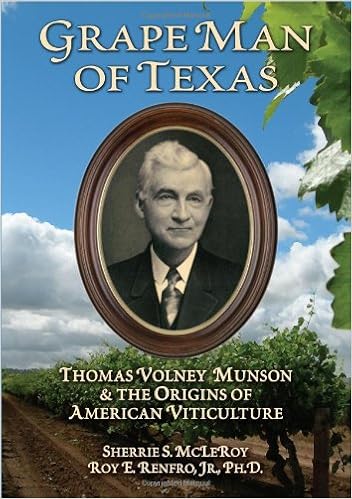
Thomas Volney Munson (1843-1913)

__________________________________________________________________________

Horticulturist, Thomas Volney Munson, was instrumental in saving the grape in Europe. He found a grapevine, in Texas, resistant to disease. Through study and a grafting program, scientist were able to use the Texas grapevine to restore vineyards throughout the world. He found the rootstock in Denison, Texas.


Seeing the Proverbial Forest for the Trees

Mustang grape vine growing on the trunk of one of my oak trees and into the canopy, rain grapes, during the month of August. The grapevine is native to this area and one of our vines is over 50 years old. Mustang grape vines can grow very long and wide in diameter. The thick woody vines are called lianas. 


Because lianas are supported by other plants, they may conserve resources that other plants must allocate to the development of structure and use them instead for growth and reproduction. In general, lianas are detrimental to the trees that support them. Growth rates are lower for trees with lianas; they directly damage hosts by mechanical abrasion and strangulation, render hosts more susceptible to ice and wind damage, and increase the probability that the host tree falls. Lianas also make the canopy of trees more accessible to animals which eat leaves. Because of these negative effects, trees which remain free of lianas are at an advantage; some species have evolved characteristics which help them avoid or shed lianas.

Liana of mustang grape  


Grape Man of Texas: Thomas Volney Munson and the Origins of American Viticulture


Grafted grapevines saved many grape varieties


Grassroots Horticulture
2019
__________________________________________________________________________
__________________________________________________________________________

Monday, September 1, 2014

Part XII | San Diego | Vineyard and Winery

________________________________________________________________________________
_________________________________________________________________________


 Orfila Vineyard and Winery, Escondido, California


More than 40 acres of the Orfila estate are dedicated to Syrah, Sangiovese, Merlot, Montepulciano, Viognier, Marsanne and Roussanne grapes.


Winery
The oak barrels impart many of the subtle characteristics including color, flavor, tannin profile and texture. 

I have created an "artsy" vignette  of the photographs as a remembrance of our trip.  The word vignette (vignette, "little vine.") comes from the division of large vineyards into 500 square meter vineyards. 


Visiting San Diego

Part I San Diego Zoo | Balboa Park | Erythrina​​
Part II San Diego Zoo | Balboa Park | Pollinator Habitat​
Part III San Diego Zoo | Balboa Park | Hawaiian Native Plant Garden
Part IV​ San Diego | Lavender Farms
Part V San Diego | Succulents and Tropicals
​Part VI San Diego | Iris, Bird of Paradise, Cactus, Desert, White Sage
Part VII San Diego | Cabrillo National Monument Old Point Loma Lighthouse
Part VIII San Diego | Exotic Plants
Part IX San Diego | Trees
Part X | San Diego | Coronado Island
Part XI San Diego | Making Music with Exotic Woods | Taylor Guitars
Part XII San Diego | Vineyard and Winery
Part XIII San Diego | Fort Rosecrans National Cemetery
Architecture and Design in San Diego


©  Grassroots Horticulture
2000-2015


________________________________________________________________________________
________________________________________________________________________________