
_________________________________________________________________
(updated)
Hardy amaryllis | Hippeastrum johnsonii
The Amaryllis blooming here are hardy amaryllis or St. Joseph's lily and are easily confused with the tropical amaryllis found in many nurseries at Christmas time.

The Amaryllis you see above were grown in Louisiana, brought to Texas, and are over fifty years old. They are what gardeners call a pass along plant or in this case a pass along bulb. After they bloom in the spring, the energy produced in the leaves goes into reproducing additional bulbs, ideal for propagaton and passing along to friends and family.
From my research the Hippeastrum, (From the Greek hippeus (knight) and astron (star)) originated in Mexico, the Caribean Islands, and South America. All Hippies are Amaryllis but not all Amaryllis are Hippies. To confuse matters even more, The Amaryllis family includes additionally related bulbs Crinum and Spider lily.

The Hippie I have is a hybrid. The story about this hybrid goes as follows, around 1750, John Johnson, a clockmaker living in Prescot, England took the Latin named, Hippeastrum reginae known additionally as Amaryllis de la reine (Mexican Lily) and crossed it with Hippeastrum vittatum producing Hippeastrum johnsonii. Raised by Johnson in Lancashire, England, 1810, and a year later by the Dean of Mancester University, Henry William Herbert, son of the botanist.

Hippeastrum johnsonii known as St. Joseph's lily is the common Amaryllis of our Southern gardens. It is one of the best for the beginner, as it flowers readily, is very fine, and slightly fragrant. Ideal for cut gardens to use in floral bouquets it last several days. Other hippies can be found at the Pacific Bulb Society website if you would like to try additional colors. https://www.pacificbulbsociety.org/pbswiki/index.php/Hippeastrum
Choose a site for this bulb in full sun to light shade outdoors It is hardy and does not need to be dug out during the winter to survive in zones 7-11 . Allow enough space for the flower to make a big statement in early to mid-spring. It has a height of 22-26"

The lily is associated with St. Joseph, spouse of Mary, through an ancient legend that he was so chosen from among other men by the blossoming of his staff like a lily. St. Joseph's Day is March 19. In religious art the lily is used as an emblem of St. Joseph, and similarly in religious flower symbolism the names "St. Joseph's Staff" and "St. Joseph's Lily" have been applied to a number of flowers.
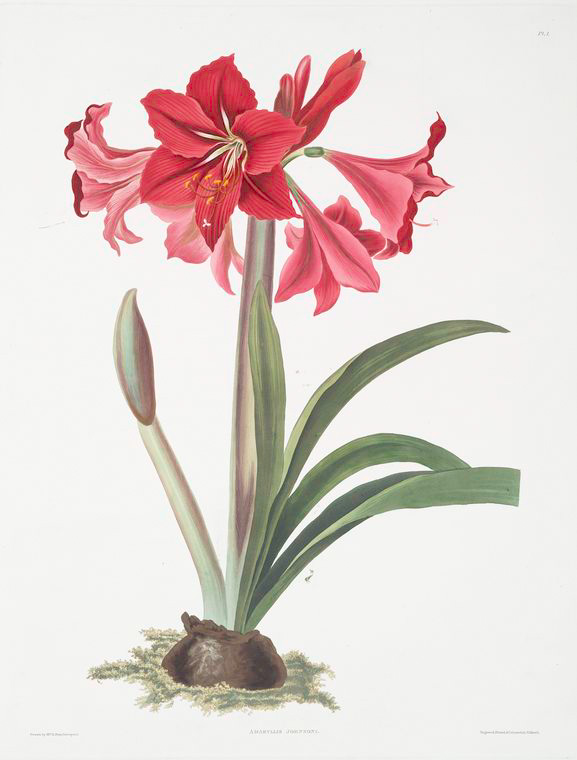
Amaryllis Johnsonii renamed Hippeastrum johnsonii
from: Selection of Hexandrian plants, belonging to the natural orders Amaryllidae and Liliacæ, from drawings by Mrs. Edward Bury, Liverpool, 1831-1834. Havell, Robert (1793-1878) (Engraver) Source: From The New York Public Library
Historical Botanical Artists with Hippeastrum Illustrations
Historical botanical illustrations were made of this flowering plant by Les liliacées (1805-1816) by Pierre-Joseph Redouté (1759 - 1840).Futher Reading

Hippeastrum : The Gardener's Amaryllis, Portland : Timber Press, 2004.
"The hybrids of Hippeastrum, also known by gardeners as amaryllis, have long been popular indoor plants, their flamboyant blooms bringing cheer during the dark winter months. Published in association with the Royal Horticultural Society as part of our Plant Collector Guide series, this book for gardeners describes the astonishing range of hybrids now available and explains how to get the best results from these rewarding plants. A wealth of practical advice accompanies the plant descriptions, including a specially formulated growing medium used by the Royal Botanic Gardens, Kew, an effective "hot water treatment" for pests, and essential advice on feeding, watering, and lighting."
"The hybrids of Hippeastrum, also known by gardeners as amaryllis, have long been popular indoor plants, their flamboyant blooms bringing cheer during the dark winter months. Published in association with the Royal Horticultural Society as part of our Plant Collector Guide series, this book for gardeners describes the astonishing range of hybrids now available and explains how to get the best results from these rewarding plants. A wealth of practical advice accompanies the plant descriptions, including a specially formulated growing medium used by the Royal Botanic Gardens, Kew, an effective "hot water treatment" for pests, and essential advice on feeding, watering, and lighting."
____________________________________________________________________________________
____________________________________________________________________________________