
 |
| Pink Water Lilies Monet, inspired by techniques he found in Japanese art, and groomed by Renoir, he idealized nature and landscapes following fixed laws; the proportionate distribution of areas, the tangential curvature of lines, and the radiation from a parent stem, and created in 1873, Impression Sunrise, the painting for which the entire Impressionist movement was named.
|
 |
| Impression Sunrise 1873 Musée Marmottan Monet, Paris |


His house was filled with Japanese wood block prints. Japanese art and culture played an important role in his vision of the ideal in nature. Claude Monet's collection is composed of forty-six prints by Kitagawa Utamaro (1753-1806), twenty-three by Katsushika Hokusai (1760-1849) and forty-eight by Utagawa Hiroshige (1797-1858), that is to say one hundred and seventeen out of the two hundred and eleven exhibited, plus thirty-two prints held in reserve.

Light and shadow
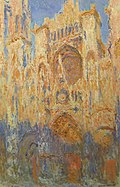
Monet and the Japanese artists used the research technique of “serie”. The artists captured the same motif, at different times of the day.

 |
| Monet's garden |
White Water Lily

Monet's lilies were a conception for a limited palette applied with rapid brushstrokes, using lead white, cadmium yellows, vermilion, red alzarian lake, cobalt blue, cobalt violet, viridian green, ultramarine blue, emerald, and chrome.

Pendulous White Flowers


 |
| Monet's palette Musee Marmottan Monet, Paris, France, Giraudon The Bridgeman Art Library |
The Dallas Museum of Art had an exhibition named,
The Fifty-Three Stations of the Tōkaidō
It is an exhibit of 53 Japanese woodblock prints illustrating village stops along a route through the mountains from Edo to Tokyo. We have 4 woodblock prints by Hiroge Yoshito and now I understand why they are called "part of the travel series". Each village was known for a certain part of their culture. Several villages were market towns, one village was known for tie-die, there were those beautiful arched bridges, one village was a red light district, Mt. Fuji is featured in many, Buddhist and Shamin Temples have that pagoda-like architecture, and there is even a mountain pass known for thieves. I cannot remember any of the village names but the exhibit was helpful to my understanding. We went to the Claude Monet house and garden in Giverney, France in 2000 and the interior of his house was filled with Japanese woodblock prints. His art was inspired by all the woodblock prints he found. It is fascinating to me, to put all this together.
______________________________________________
Here are a couple of my woodblock prints.
 |
| Misty Day in Nikko |


Hiroshi Yoshida (born Hiroshi Ueda) was born in the city of Kurume, Fukuoka, in Kyushu, on September 19, 1876.[1] He showed an early aptitude for art fostered by his adoptive father, a teacher of painting in the public schools. At age 19 he was sent to Kyoto to study under Tamura Shoryu, a well known teacher of western style painting. He then studied under Koyama Shōtarō, in Tokyo, for another three years.
In 1899, Yoshida had his first American exhibition at Detroit Museum of Art (now Detroit Institute of Art). He then traveled to Boston,Washington, D.C., Providence and Europe. In 1920, Yoshida presented his first woodcut at the Watanabe Print Workshop, organized byWatanabe Shōzaburō (1885–1962), publisher and advocate of the shin-hanga movement. However, Yoshida's collaboration with Watanabe was short partly due to Watanabe's shop burning down because of the Great Kanto earthquake on September 1, 1923.
In 1925, he hired a group of professional carvers and printers, and established his own studio. Prints were made under his close supervision. Yoshida combined the ukiyo-e collaborative system with the sōsaku-hanga principle of "artist's prints", and formed a third school, separating himself from the shin-hanga and sōsaku-hanga movement.
Hiroshi Yoshida was trained in the Western oil painting tradition, which was adopted in Japan during the Meiji period. Yoshida often used the same blocks and varied the colour to suggest different moods. The best example of such is Sailing Boats in 1921. Yoshida's extensive travel and acquaintance with Americans influenced his art considerably. In 1931 a series of prints depicting scenes from India, Pakistan, Afghanistan, and Singapore was published. Six of these were views of the Taj Mahal in different moods and colors.
Bibliography_____________________________________
- Claerhout, François, Claude Monet, L’œil et le monde, les Années à Giverny : 1883-1926, 2005
- Leuck, Krista, Claude Monet’s Japanese Print Collection, 13 April 2007.
- Echaubard, Laurent, La collection d’estampes japonaises
- Cauderlier, A., Monet’s collection of Japanese WoodBlocks, 14 April 2006 [Online] Available : http://www.intermonet.com/japan/
- Aloi, Giovanni, what other's Don't tell you about Monet's Waterlilies.
- (https://youtu.be/Kj56NGwjdlc)
Why look at plants? : the botanical. emergence in contemporary art / written and edited by Giovanni Aloi. Leiden ; Boston : Brill Rodopi, [2019] Japanese Woodblock Print Information
- The Production of Japanese Woodblock Prints
- The Development of the Woodblock Printing Process
- Japanese Woodblock Print Artists' Names
- Actors' Names in Japanese Woodblock Theatre Prints
- Woodblock Print Artists' Biographies
- Painting Schools and Art-Names (Go)
- Date Seals and the Japanese Calendar
- Beginning Woodblock Collector's Bibliography
- Glossary of Woodblock Print Terms
Japanese Woodblock Print Reference Material
- Zodiacal Calendar Date Seals
- Nanushi Censor Seals
- Utagawa Kunisada Print Series Cross-Reference
- Print Series of Ando Hiroshige, in Edward Strange
- Print Series of Ando Hiroshige, in Van Vleck
Japanese Woodblock Print Series
- Haribako-E
- Hiroshige's '8 Snow Scenes of Tokyo'
- Hiroshige's 'One Hundred Famous Views of Edo'
- Yoshitoshi's 'One Hundred Aspects of the Moon'
Other Japanese Information
© 2023 Grassroots Horticulture
__________________________________________________________________________________________________
http://www.visual-arts-cork.com/artist-paints/colour-pigments.htm