
 |
| Frida Kahlo, Rasario's Restaurant Margarita and Agave, the source of tequila. |

Frida Kahlo (July 6, 1907 – July 13, 1954) was a Mexican painter. She painted using vibrant colors in a style that was influenced by indigenous cultures of Mexico and European influences including Realism, Symbolism, and Surrealism. Many of her works are self-portraits that symbolically articulate her own pain and sexuality. Kahlo was married to Mexican muralist Diego Rivera. On September 17, 1925, Kahlo was riding in a bus when the vehicle collided with a trolley car. She suffered serious injuries in the accident, including a broken spinal column, a broken collarbone, broken ribs, a broken pelvis, eleven fractures in her right leg, a crushed and dislocated right foot, and a dislocated shoulder. An iron handrail pierced her abdomen and her uterus, which seriously damaged her reproductive ability. She would be plagued by relapses of extreme pain for the remainder of her life.  After the accident, Kahlo turned her attention away from the study of medicine to begin a full-time painting career. The accident left her in a great deal of pain while she recovered in a full body cast; she painted to occupy her time during her temporary state of immobilization. Her self-portraits became a dominant part of her life when she was immobile for three months after her accident. Kahlo once said, "I paint myself because I am often alone and I am the subject I know best." .jpg)   The meaning of the color of Frida Kahlo’s paintingsKahlo's paintings were rich in bright vibrant colors. In her diary, Frida attempts to explain the meaning of the colors used in her works (information from fridakahlofans.com): "I’ll try out the pencils sharpened to the point of infinity which always sees ahead" The meaning of the color of Frida Kahlo’s paintings If you look at Kahlo’s paintings. The first thing that catches your eye are the colors. Because her paintings are rich in energetic, vibrant and bright colors. Frida herself has written in her daily memoirs the meaning of some of the colors used in her paintings.
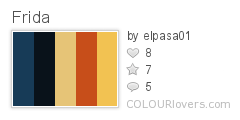
Magenta: Aztec symbol. Old TLAPALLI blood of prickly pear, the brightest and oldest. Cobalt Blue: The symbol of electricity and purity love. Navy Blue: The symbol of distance. Also tenderness can be this blue. Dark Green: A symbol of bad advertisements and good business. Green: Symbol of good warm light. Leaf Green: The symbol of leaves, sadness, science, the whole of Germany is this color. Greenish Yellow: The symbol of more madness and mystery. All the ghosts wear clothes of this color, or at least their underclothes. Yellow: The symbol of madness, sickness and fear. Part of the sun and of joy. Red: A symbol of blood? …. Well, who knows! Brown: Mole symbol, leaves becoming earth. Black: Symbol of nothing. Nothing is black – really nothing |


Inspiration. 


.jpg)


~~~~~~~~~~~~~~~~~~~~~~~~~~~~~~~~~~~~~~~~~~~~~~~~~~~~~~~~~~~~
Frida Kahlo Palettes and Patterns






The visionary and supremely self-fashioning artist Frida Kahlo (1907–54) drew inspiration throughout her career from arte popular―painted ceramics, embroidered textiles, religious votives, effigies and children's toys, and other objects created in Mexico’s rural and Indigenous communities. The hundreds of folk-art objects that filled her home and studio attest to her nationalist politics and her fascination with the work of carvers, weavers, sculptors of papier-mâché and vernacular painters. She depicted these objects in her paintings and adopted elements of traditional dress and ornament in her own self-presentation, playing on modernist fascination with folk culture and on her own relation to layered Mexican identity. This bilingual book, the first in-depth exploration of Kahlo’s varied and sophisticated responses to arte popular, situates her within the broad artistic and intellectual movements of her time, examines her professional ambitions and illuminates the innovative techniques she used in her lifelong encounter, both playful and powerful, with the folk art of Mexico.
No comments:
Post a Comment